





The Gion Festival "and" Takayama which restored in about 200 after. A highlight of attention will be introduced from now on.

An offer: Takayama preservation meeting
Charming sights in summer of Kyoto "the Gion Festival". "Yamaboko tour" of a main event was performed in 3 after via a Corona misfortune in 2022, but I was "Takayama" of the form that it's heroic that a flower was added to the protuberance (A cogon, oh.) Via a long stop, for 196 years after, with further rehabilitation will be a festival and is expected of Takayama who achieved tour return from now on. I'll introduce the Takayama's history which isn't learned about, a highlight and an attention point after 2023 here.
With highlights of the Gion Festival "yamaboko tour"?

The "Gion Festival" which is one of a Japanese three big festival is the galay performed for 1 month in July at Yasaka-jinja in Kyoto and Gion. The origin has started as the Shinto Ceremony to which I pray for a dispersal of the plague which spread in Kyoto in the 9th century. July 17 when highlights of a festival receive Mikoshi Shrine with deities in Yasaka-jinja into a town "the previous festival (the previous festival)" and July 24 when Mikoshi Shrine is returned to a shrine, ", with festival (after festival)" of 2 days. But a luxurious yamaboko also does "yamaboko tour" going around a main street (And, oh, pike Jun misses.) before Mikoshi Shrine going out with a couple of days. The number of the yamaboko is the previous festival, 23 sets, with it's a festival 11 sets. Its form that I have sneaked from a picture scroll at all is called "moving museum", and is registered with an intangible cultural heritage of UNESCO.
Takayama's ABC: History in 500 and the pace until the rehabilitation

It's said to be an early stage (the 14th century) that a yamaboko tour of the Gion Festival has started in Muromachi era. Anything there is a record close to 60 yamaboko match in the "Onin war" (1467) before when a town in Kyoto was burned out, and much of a yamaboko which exists follows from this time with what? When it's the one, it's said that Takayama who returned to a tour in 2022 was called "Mt. hawk stem day" according to Yamada Junji chief director of Takayama preservation meeting, too. Because derivation of the name is being done in the motif of the "falconry" which uses a hawk and hunts a game. It was the small mountain carried by a shoulder at the beginning, but it develops into a hikiyama with a big roof (A pull and, oh.) later. It'll be the mountain where order of the tour is decided every year, with it's a festival I came to appear on the 2nd from the end.

I was Takayama who has such history, but it'll be the "Mt. holiday" when I don't take a tour from the next year because it suffered big damage because of the heavy rain in 1826 (1826). The way of tour return burned most of the body and an ornament away by a conflagration which involves more gates of Imperial Palace in Bakumatsu strangely, and was something steeper. It's from around 2012 which has passed from tour suspension for nearly 190 years that a time of the rehabilitation rose. A study meeting for rehabilitation and an investigation start a volunteer in the town and a researcher in the center, and a musician of the band (how to grow) is also formed in 2014. I'm also supported by support from the whole country and craftsman work of Kyoto and restore a mountain in 2022 at last. The tour return which was long-cherished dream was achieved.
The reason that it was possible to revive via about 200

What kind of reason and background will there be in Takayama's can revive like the phoenix while passing at a blank for close to 200 years? Yamada chief director, "I'm Takayama who burned everything away mostly by Ikuta's accident, only the important divine object could be protected and succeeded importantly at a town.", I speak. The one with which a head and an arm of 3 divine objects which exist were made for the middle of Edo period before more than 250 years actually. I'm certain that this existence was grounds at the big heart for people in the town. "The Takayama's record on which Edo latter period was recorded during tour suspension is also transmitted to a town. The record for which pioneers left it believed the renaissance of the posterity and was very useful.".
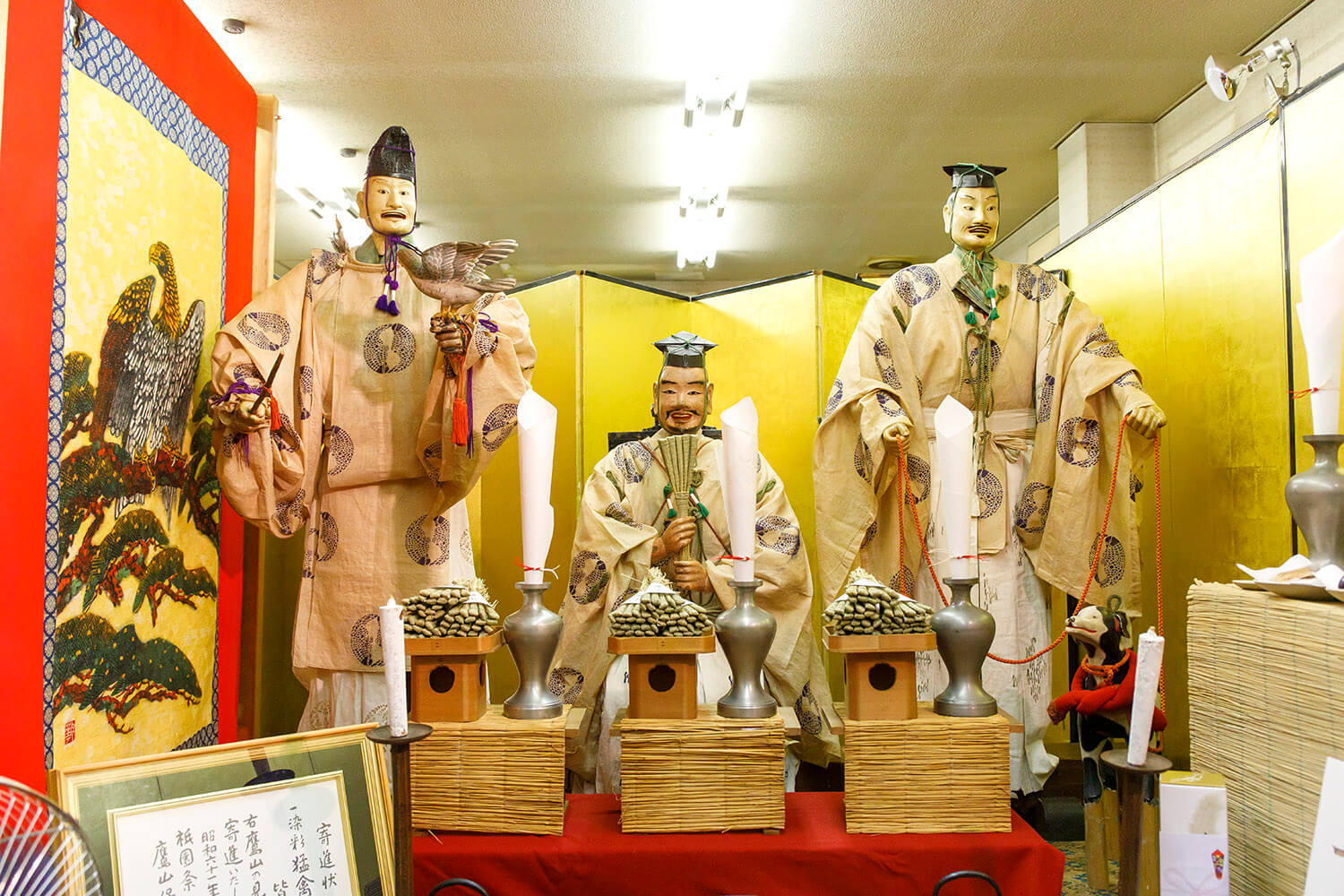
"Inukai (Was it a dog?)" and the tool out of which the Takayama's divine object pulls "Hawker (Or, I shouldered.)" and the hound which treat a hawk were put in, a barrel, it's announced by a club in Koromonotanacho, Nakagyo-ku on July 22 and the 23rd every year by 3 bodies of "barrel negative" of the follower who shoulders (barrel assumption). A court noble in the Heian Period and Ariwarano Yukihira are told with the situation which does falconry by emperor's going out and have the elegant atmosphere somehow.
Close adherence! Takayama's Gion Festival 2022
I look back to 1 month of Takayama who restored in 2022 by photograph. A yearly event schedule doesn't change, so please make it the reference when visiting next time.
◉July 5 With a good luck mark.
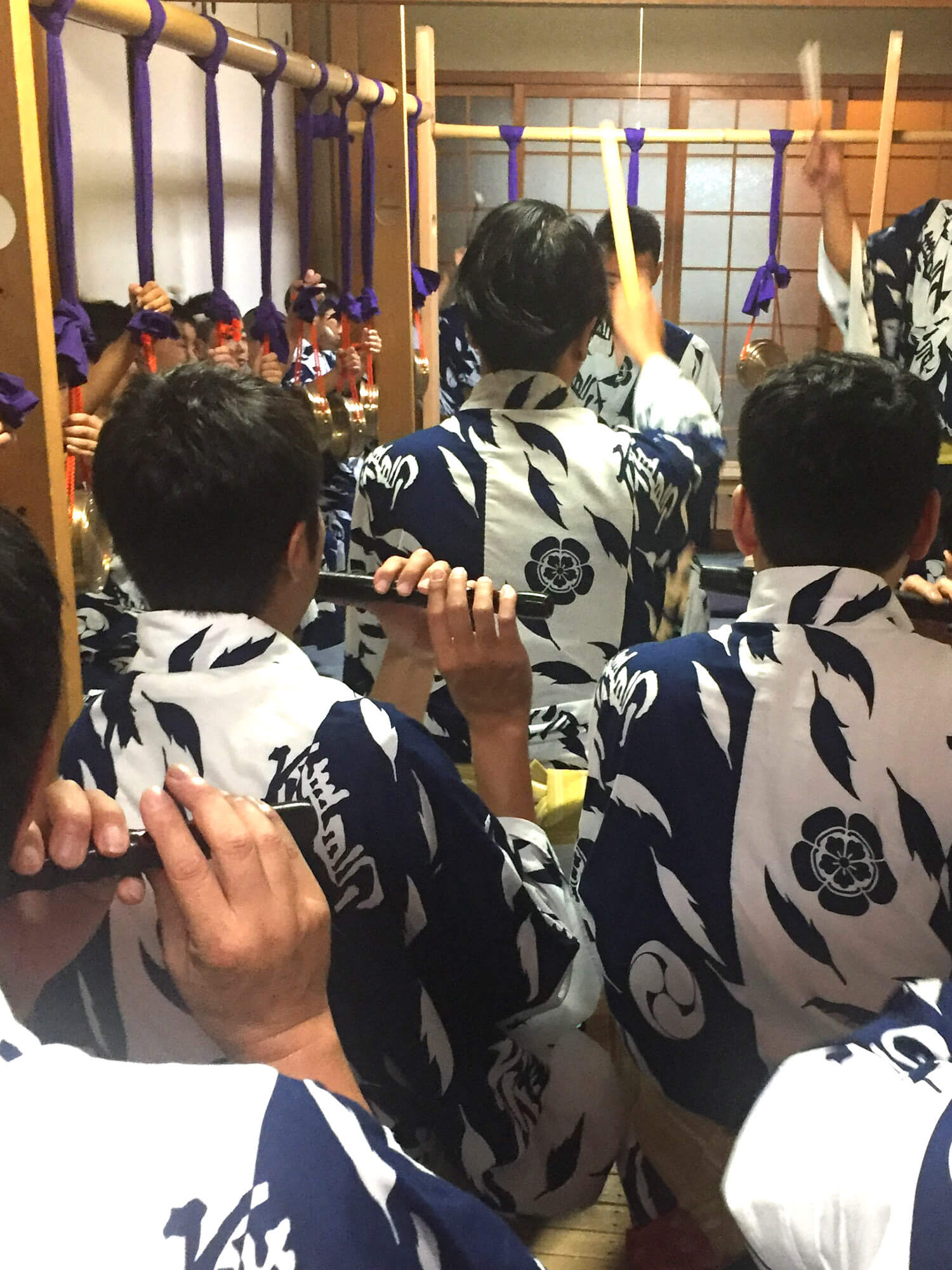
It's called "Good luck mark enter (I enter a ticket.)" at the beginning of Shinto Ceremony of the Gion Festival, and it's performed at a town of each yamaboko. The yukata which is performed on July 5 by Takayama and it's match from this day, it's put on, and, musical accompaniment rehearsal starts. A musical accompaniment is played by the traditional Japanese music capacity of 3, a drum, a bell (money) and a pipe (fife used at Noh play), and children participate, too. The light sound of the Conti chitin rang in faint bottom of the light and street of a festival paper lantern.
◉July 18-the 20th Mountain building

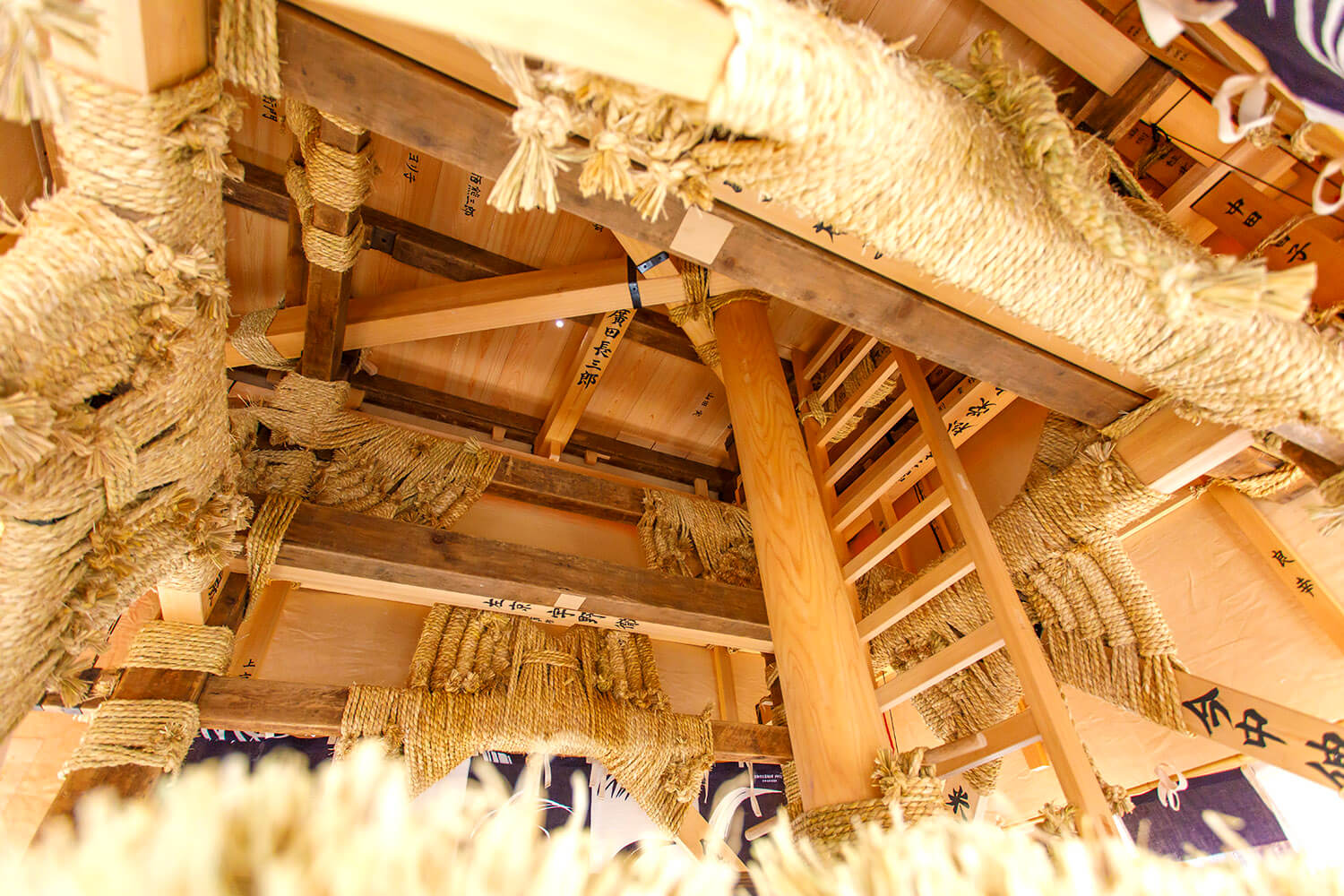
With a festival in mountain building has started with Takayama who participates from the early morning on the 18th next day when the previous festival has been finished. A basic part of a yamaboko is put together by the traditional technique which doesn't use a nail and winds the straw rope called "rope related". Assembly has been completed safely though it meets with a temporary torrential downpour on the 2nd.
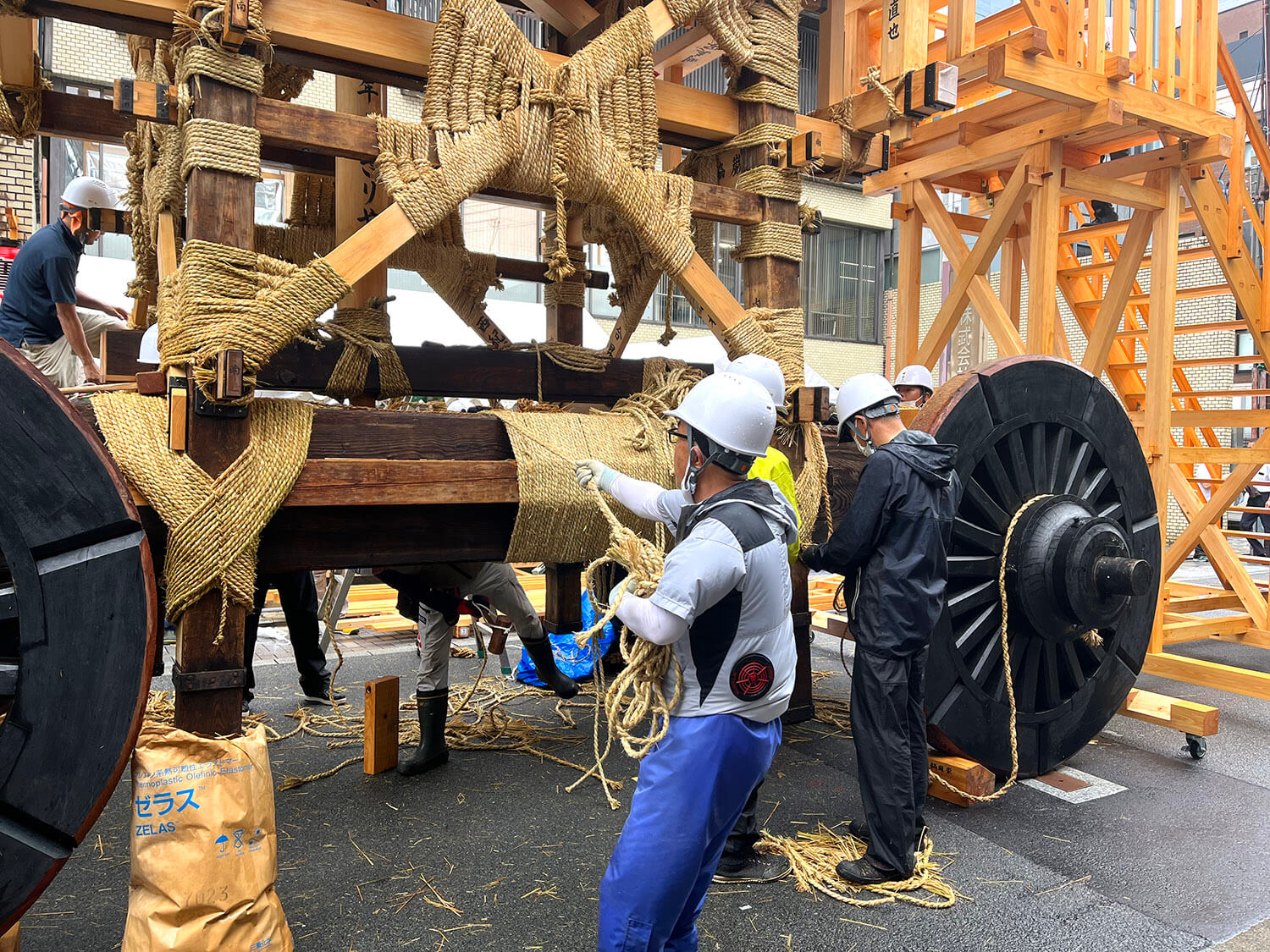
When mountain building is being seen, Takayama shows that donation is received and both of the part I have had made and the old part which feels history are being used. Well, when the turret where a stage is supported was taken over from "Kikusui halberd" and the white croaker with which the center of gravity of the mountain is supported (croaker) was taken over from "throw halberd" from "ship halberd", and repairing it, it's said that they use a big black wheel. I find out that people's a lot of expectation beyond the time is included among Takayama.

◉July 20 Pull first.

The event which tries, pulls and does the mountain I have finished putting together, "pull first (playing the musical instrument for the first time in the New Year)". A musician of the band boarded it and went back and forth between Toru Sanjo about 400 m in the mountain decorated beautifully. A route was flooded with many people in spite of a weekday, and the first one step Takayama should commemorate was watched.
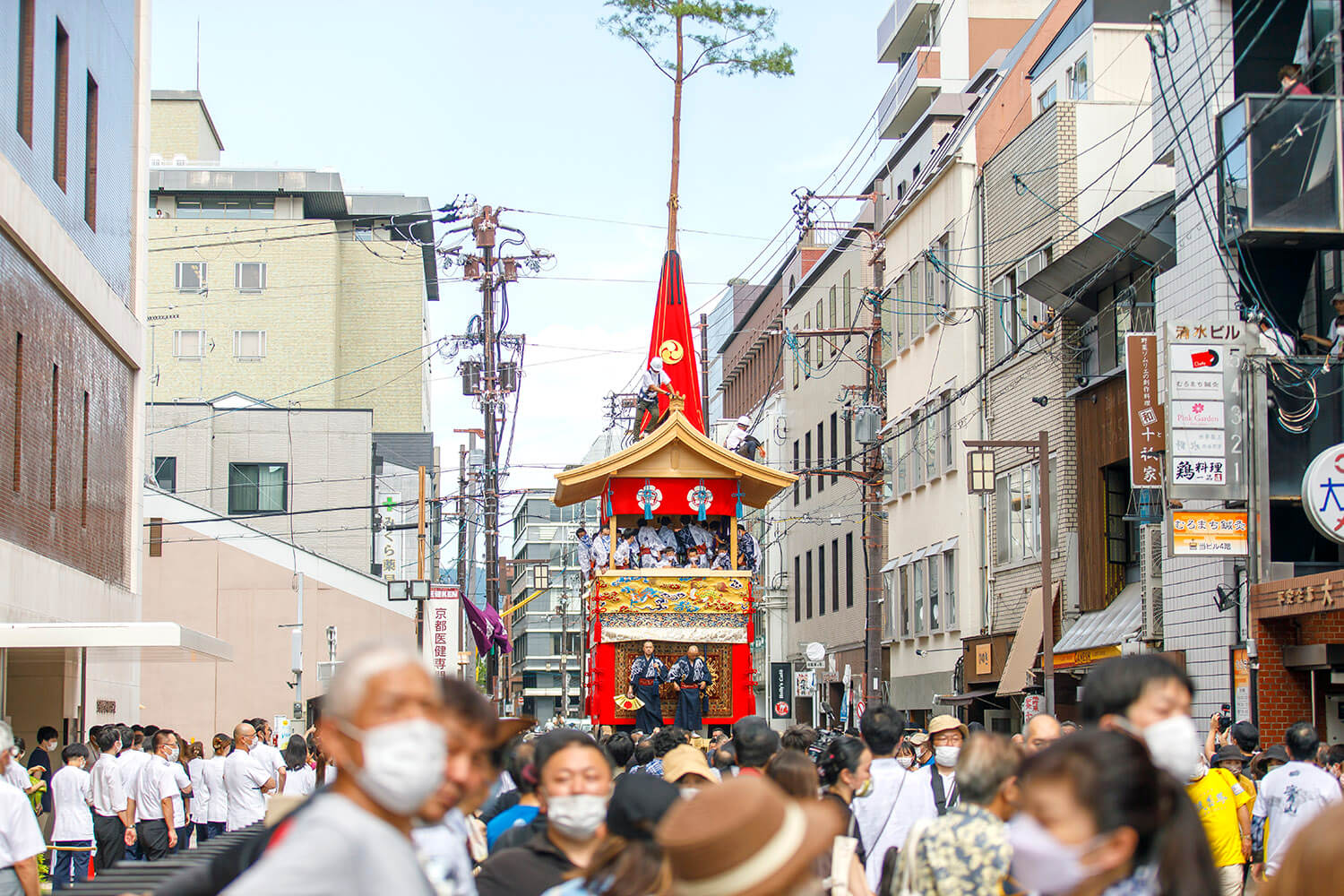
The form of the yamaboko of the Gion Festival is shared with "halberd" "Hikiyama (A pull and, oh.)" "yoyama (oysters and, oh, something a* person carries in a shoulder)" big, and Takayama is one kind of "hikiyama". It's the feature it takes pride in its size which isn't discounted to a halberd, and to make the pine called a true pine. It's said that one in the hikiyama of the Gion Festival takes pride in the maximum level beyond 10 tons of height 17m and gross weight for restored Takayama. The form that I move ahead was highlights while making a big noise creak.
◉July 21-the 23rd Mt. evening
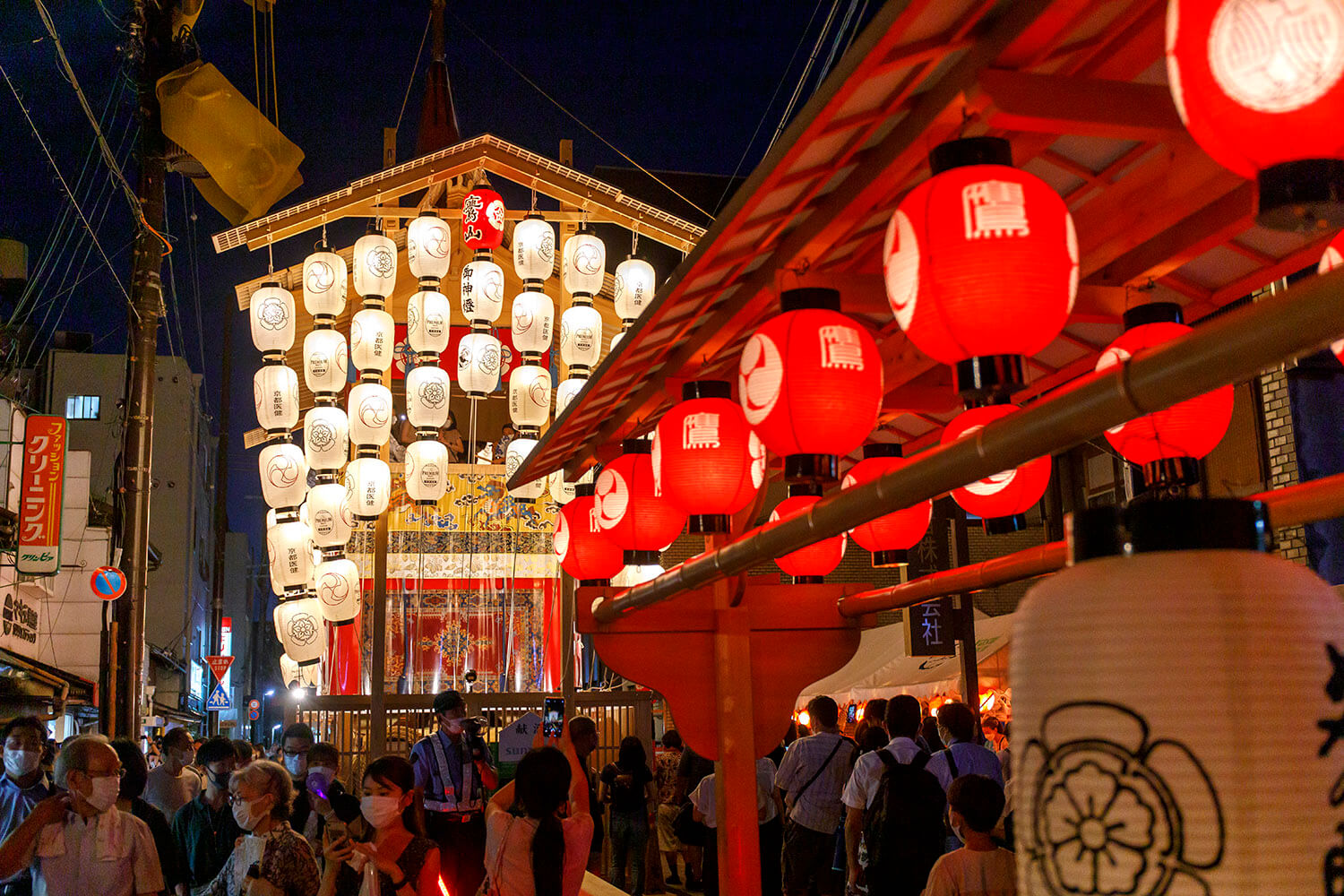
The event with which the "Mt. evening" performed 1 of the yamaboko tour-before the 3rd (It's good, oh.) is cross in an eve. A speculation, general boarding to a halberd, giving of Rice Cake Wrapped in Bamboo Leaves of an amulet and a charm and Gion festival ensemble are played at each town. In the big crowd which is to the extent Takayama who met Mt. first evening controls traffic, after rehabilitation in a mountain. When the light was added to a brand-new Komagata paper lantern, the turn was wrapped in the blaze which is to the extent it was glaring.

The "weather Shinto music and dance numbers" which wishes a clear sky of the next day's yamaboko tour (Hiyori Kagura) was also offered up in the evening on July 23.
◉July 24 With a festival a yamaboko tour

July 24, 2022. At last, in 196 after, Takayama, with it's a festival the day when I return to a yamaboko tour. It's blessed with the clear sky I don't have any more, the highest temperature is 34.7 times! The inside where heat on the route also reaches a climax and Takayama cross a main street openly and squarely, and "street turning" which are the biggest highlights (turn) also succeeds safely. Tour resurgence has been achieved excellently.

I'm Takayama who achieved long long-cherished dream on this day, Yamada chief director who explains "He has just stood as scratch line finally. It's a crucial moment from this." The look is contemplating the next future already. Takayama is planning to bet time now, display a foundation of a plain wood by a Japanese lacquer work and a gold work and take back the past splendid blaze and. "It's still a heap that it should be done and that I want to do." is explained by a smiling face.
When it sailed up history, no yamaboko were today's form in a short period. Though decoration is the inhabitant of town and is added a little every year, and restoration is also done, long years are hung, and beauty has been polished. "It's exciting Experience that history is making them revive some mountains best. Since our generation monopolizes it, it's wasteful. A bearer in the next generation is brought up, and would like to look forward to the form that they're marking the newer history." (Yamada chief director).
The pleasure will be now. How to enjoy oneself Takayama after 2023
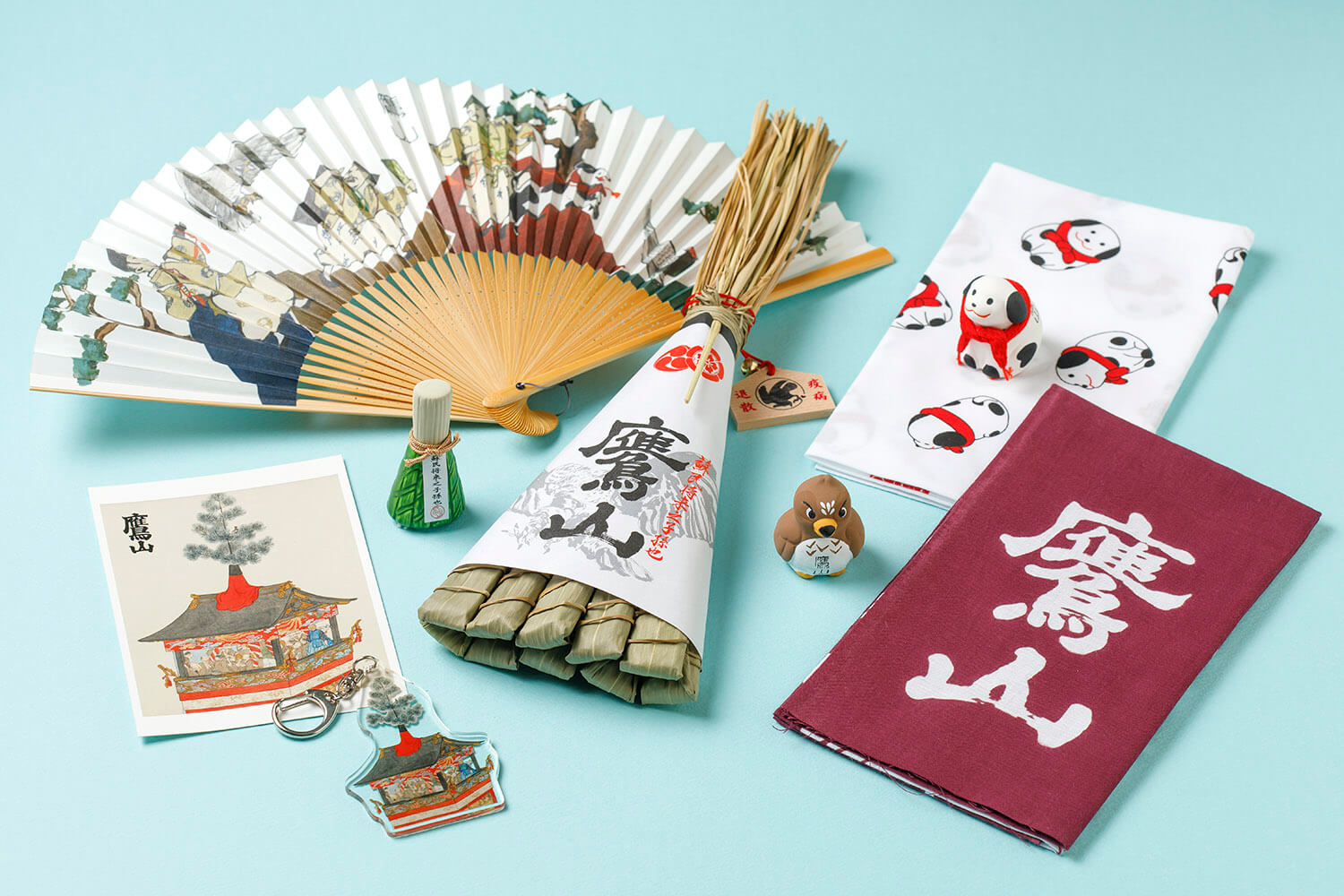
2022 and the Takayama's historical moment, because it wasn't seen, it isn't necessary to fall. Every time now when you have returned and summer clear up, and come to the center stage, even how many times is it possible to visit Takayama? And Takayama's rehabilitation has just still started. There is also pleasure which is the expert who witnesses and supports the process on which evolution is being piled every year. The collection by which the one is kind Takayama's rich giving items. The towels with which the yearly color changes including "Rice Cake Wrapped in Bamboo Leaves" of an amulet with the manly design, a lot of the lovely "hawk" "dog" "Rice Cake Wrapped in Bamboo Leaves" type, a smart fan, a picture postcard and stationery...,.... I'm also happy that the sales as well as everything's being a lucky charm become Tsutomu who supports the Takayama's future.
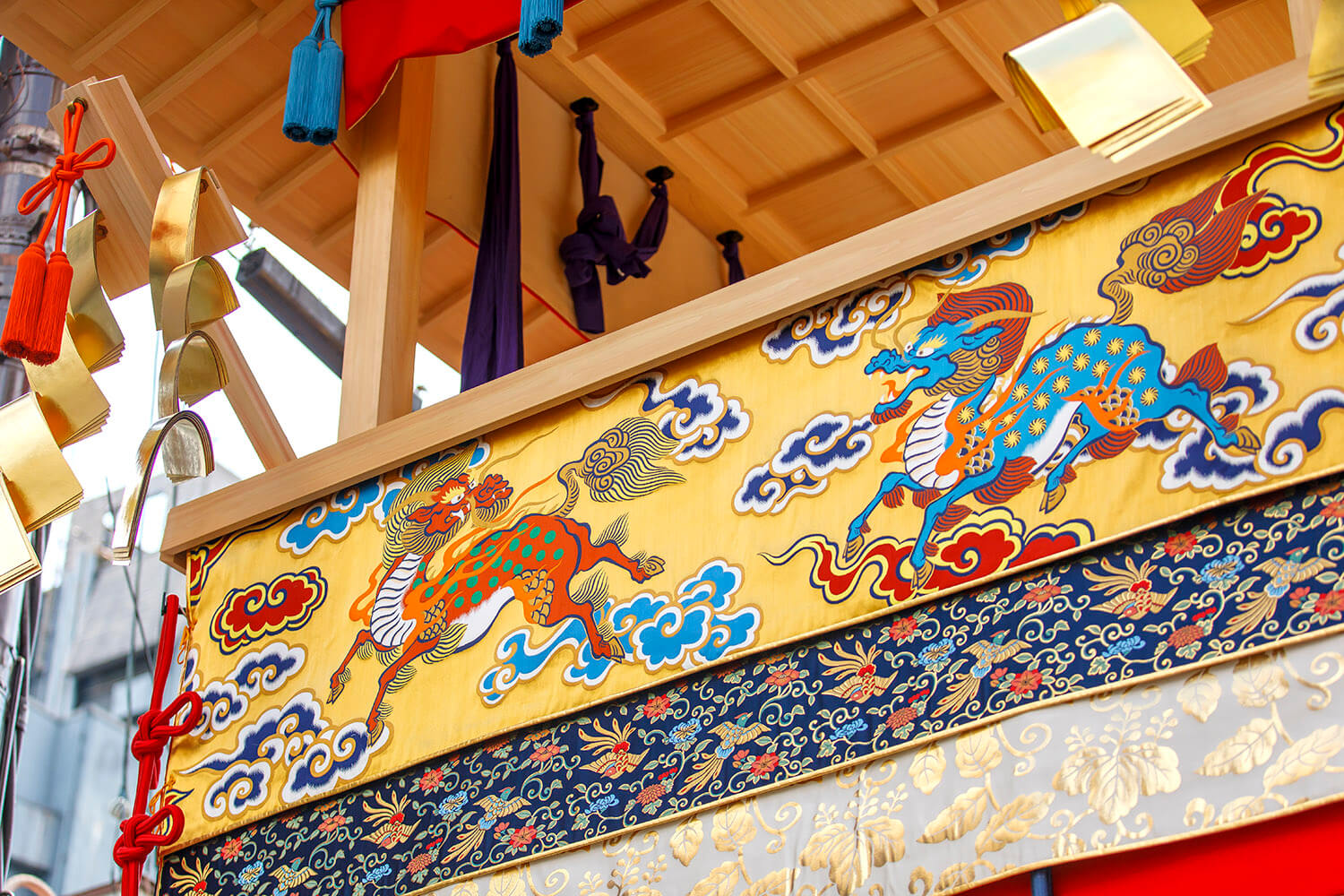
If Takayama will be visited in Mt. evening next time, it's also attention in the decor called "kensouhin (The day I'll put out, oh.)" Takayama's decoration in Edo latter period has begun to be revived by craftsman work in a capital. For example the one by which Tatsumura fabric of fine arts of Kyoto restored "Mizuhiki strings" in 3 beds where the upper part in a body is decorated (It wasn't seen and was pulled.) by minute homespun. Cloud and a giraffe (giraffe) are being surfaced and seen in three dimensions.
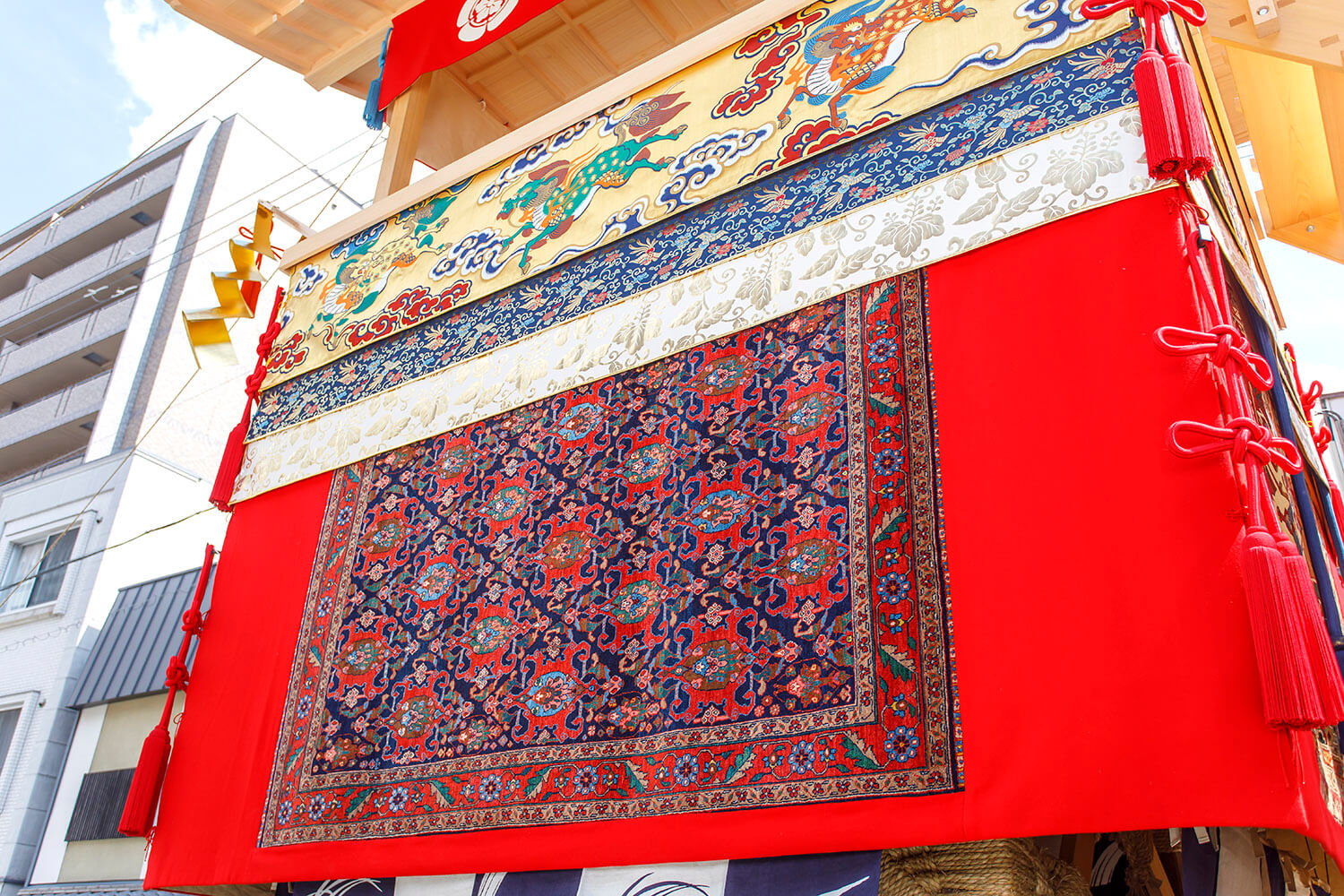
The wool which displays sack body in a mountain is the foreign-made goods I got from West Asia based on record material. The Persian carpet had made lacks antique Turkey carpet for more than 2 years at an Iranian atelier in "douken" in a side (How is it drawn?) in a front and a back plane, and is used. The design of crab, lotus and pomegranate is reproduced and surprisingly, is also exotic.

"kensou" which decorates the rear of a yamaboko (seeing off) is the place where each yamaboko displays treasure every handle. Because a dyeing person of Kyoto and Minagawa moonlight "are future rehabilitation" in 1986 by Takayama, contributed "takayukizu" (a dying color scheme bird of prey, yukizu) is decorated. When it's hit by a wind, the form that I flap and see big is also magnificent. I also overlook here and cry.
Of Takayama's history and tradition which are so deep that I know, variously. Something by which love to a festival also deepens firm when there is one yamaboko which favors (favor) in the yamaboko of 34 sets of Gion Festival. Please visit the next Gion Festival and touch Takayama's charm much by all means.
Coverage cooperation: Takayama preservation meeting
https://www.takayama.or.jp/
Special event of "OMO5 Kyoto Gion by Hoshino Resorts"

The master of MICHIKU SA who took charge of this article
-
Noriko Yamaguchi.
Edit and lighter. An article of travel, history, traditional culture and arts and crafts is written with a magazine and a web using Kyoto as a foothold. To deal with edit of a book. I like a festival, sake and a container very much. Interpretation information man (English) and international ri Sakashi. Kyoto official approval second kyuu.
 Of MICHIKU SA.
Master
OMO5 Kyoto Gion by Hoshino Resorts
The Kyoto center and Kyoto city
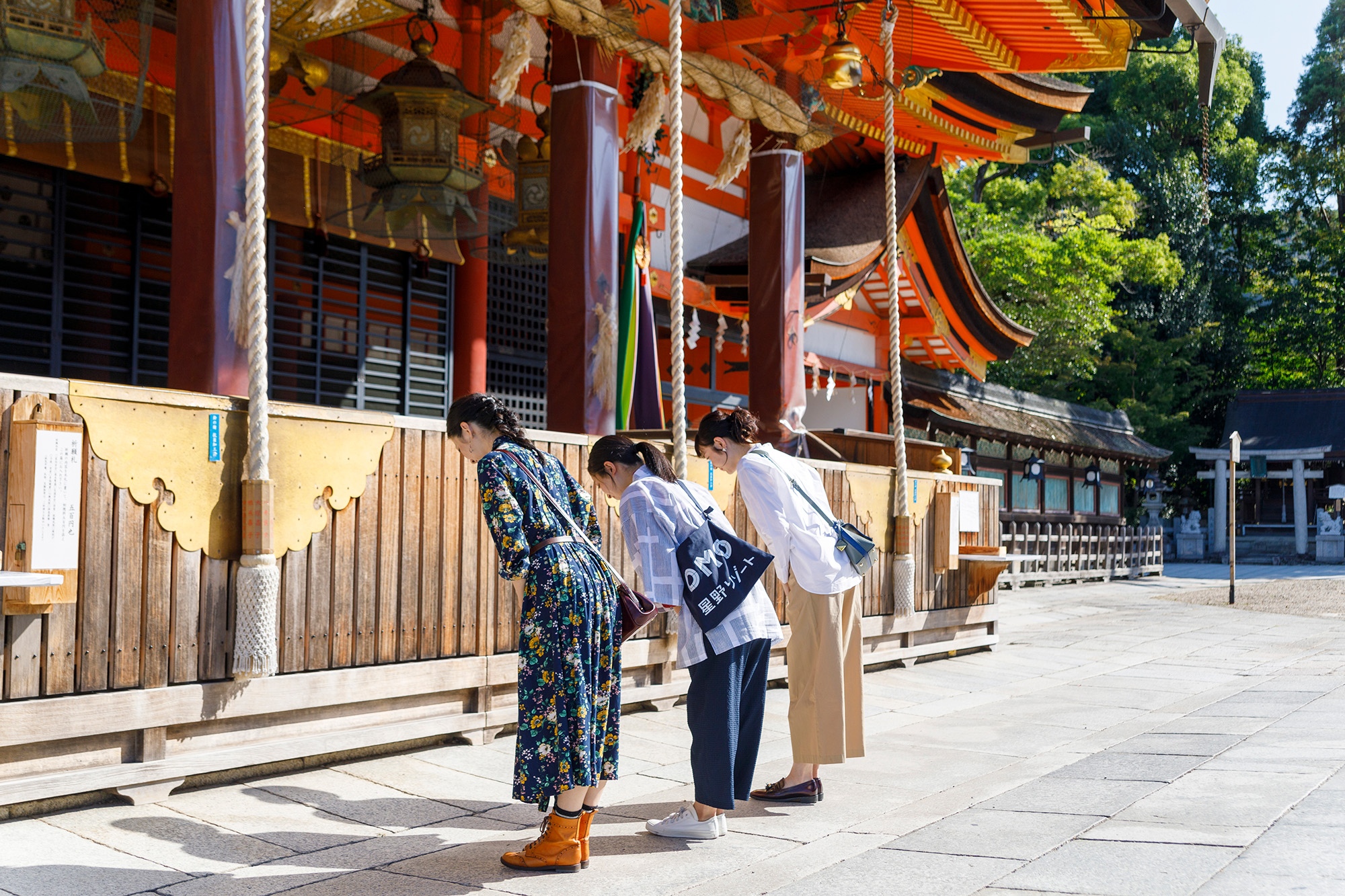
Yasaka-jinja which is here along the downtown area which represents Kyoto "Toru Shijo" and is famous for Gion Matsuri is immediateness. Everyone is convenient for sightseeing in visited Yasaka and clear water area sometime.

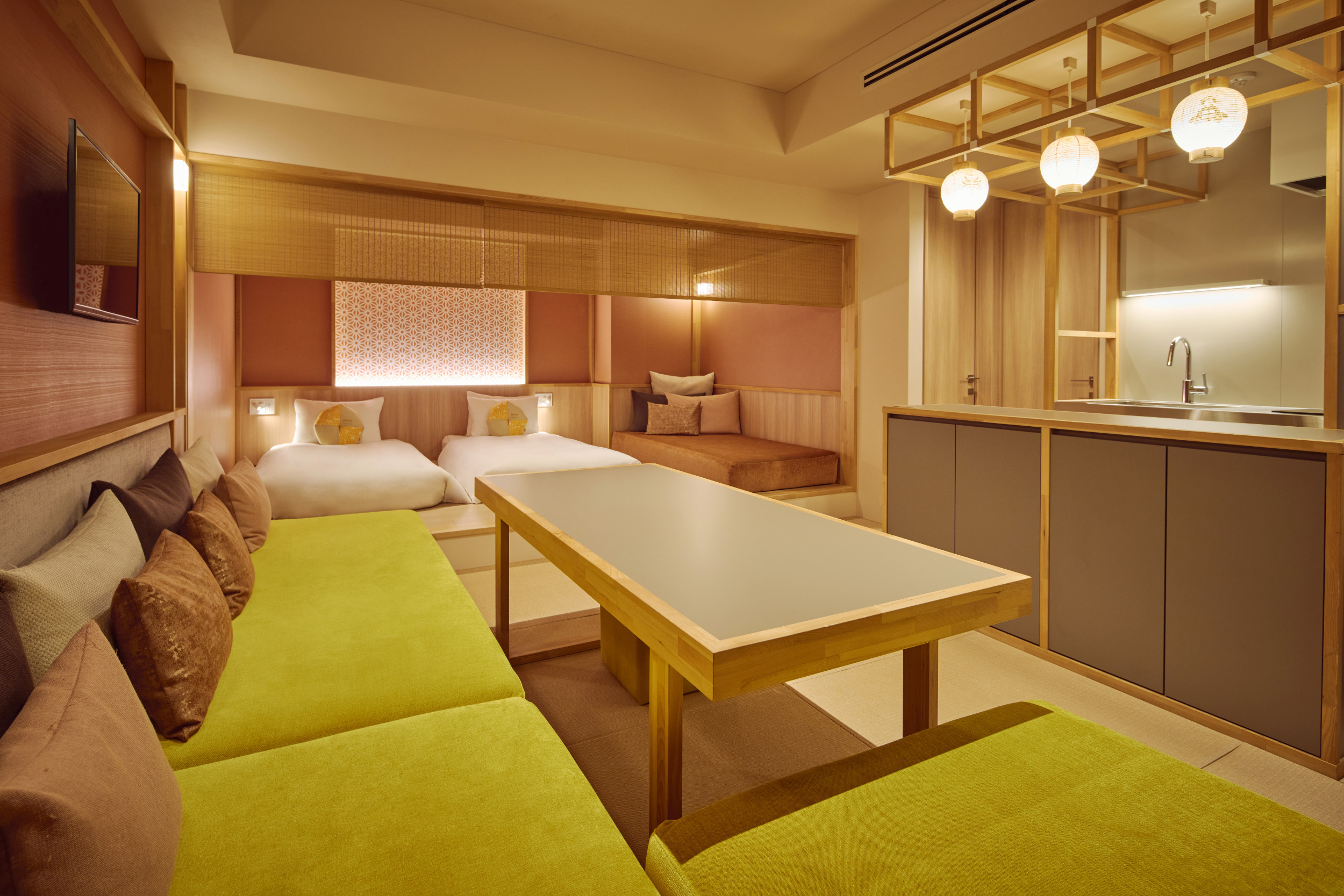

Direction Keihan Main Line Number 7 of Gion-shijo Station, from an exit, about 5 minutes on foot
- A room charge example
- 1 night, 1 person \9,500-
HOSHINOYA Kyoto
The Kyoto center and Ranzan
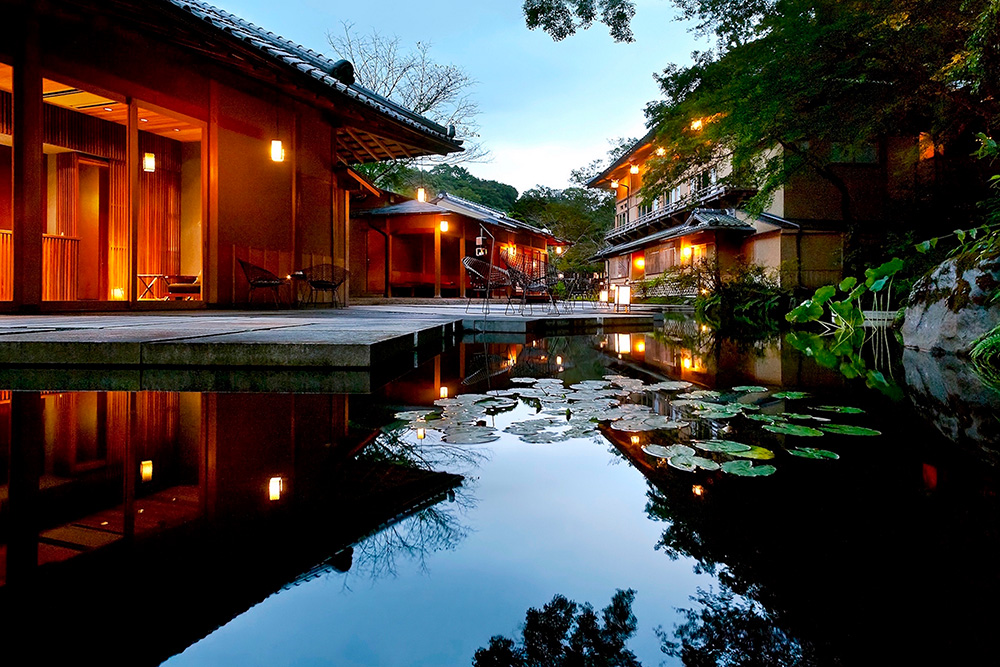
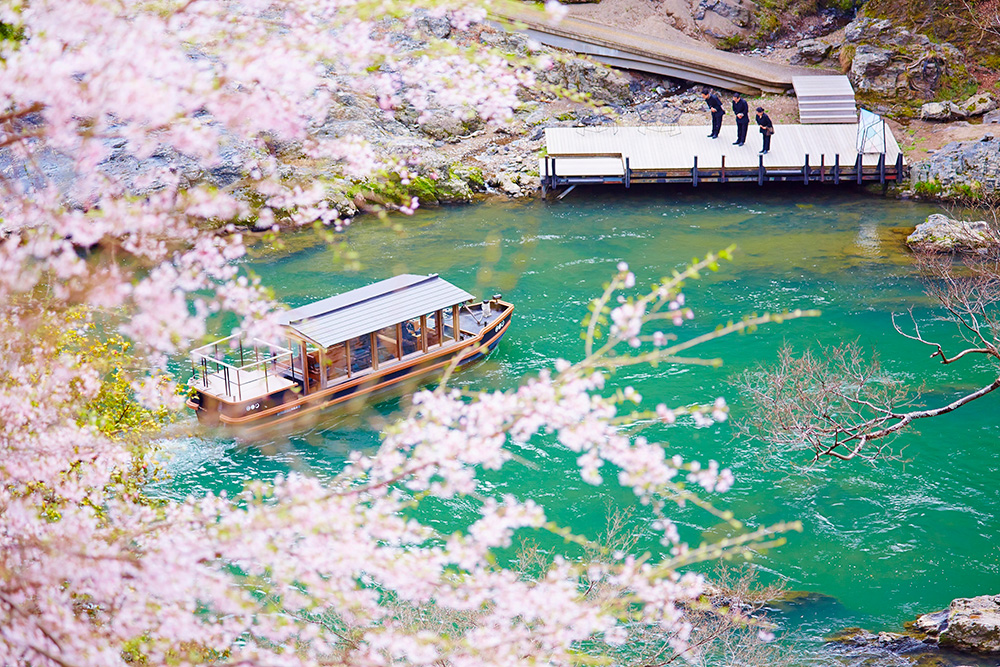
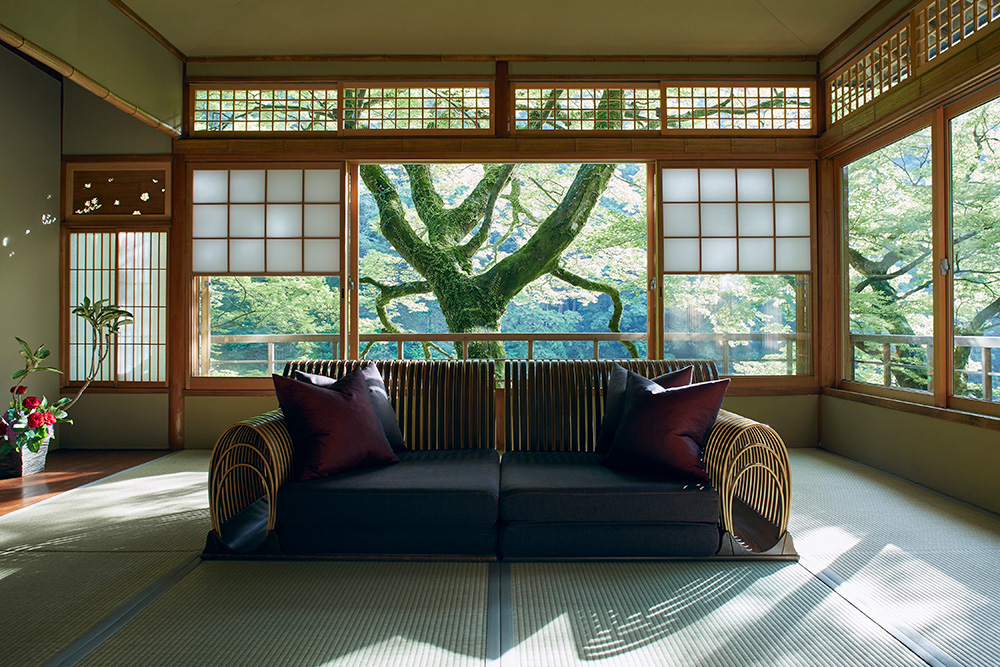
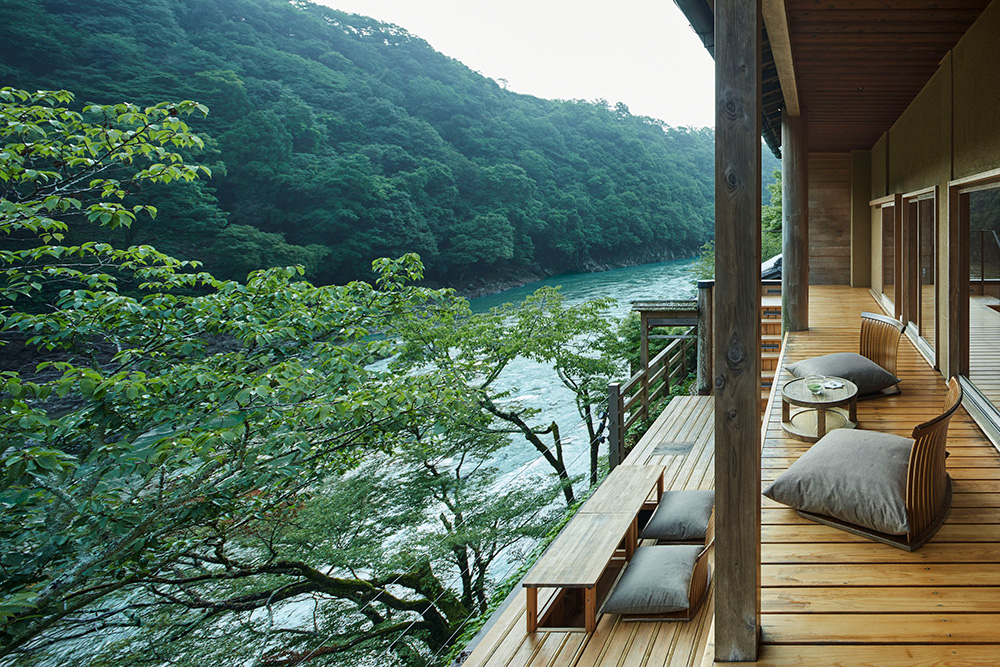
A Japanese-style hotel of River view of all the rooms located in Ranzan. Beautiful cityscape in four seasons and the quiet extraordinary world can be enjoyed.
It's a taxi from Direction JRKyoto station, about 30 minutes
- A room charge example
- 1 night, 1 person \33,330-
OMO5 Kyoto Sanjo by Hoshino Resorts
The Kyoto center and Kyoto city
Even the streets where Pontocho and Sanjo big bridge seem to be Kyoto are within the walking range. The past and present are the area which intersects from the latest store to the speciality store in a long-established store.


The Direction Kyoto municipal subway Number 3 of Kyoto Shiyakusho-mae Station, from an exit, about 2 minutes on foot
- A room charge example
- 1 night, 1 person \4,000-
OMO3 Kyoto Toji by Hoshino Resorts
The Kyoto center and Kyoto city
The hotel where I pause in the Toji Temple area which is recommended to 1 and the repeater accustomed to within 1 hour and Kyoto travel by train to Osaka and Nara by bus to a popular tourist spot in Kyoto.


From Direction JRKyoto station Hachijo mouth, about 13 minutes on foot
- A room charge example
- 1 night, 1 person \4,500-