





[2025 year edition] recommendation spot of colored leaves of Aizu rural areas (Aizu-wakamatsu, Kitakata, Bandai and Inawashiro)
![[2025 year edition] recommendation spot of colored leaves of Aizu rural areas (Aizu-wakamatsu, Kitakata, Bandai and Inawashiro)](https://hoshinoresorts.com/guide/wp-content/uploads/2019/08/fk01.jpg)
The Fukushima Aizu area where the spot by which Aizu-wakamatsu which became a stage of history, Inawashiro-ko Lake with the high clarity and grand Bandai-san made mountain symbol of religious faith from the old days in Bakumatsu (It's BA N, Isa, oh.) tickle emotion for traveling is many. A vertical drop in a basin and a mountain region is also the area where colored leaves can be enjoyed lengthily roughly. The colored leaves which have begun to color from Bandai-san and around Inawashiro-ko Lake around the end of September hang about 1 month, and I'll get off in Aizuwakamatsu-shi with "crane KE castle". One in such Aizu rural areas will introduce a spot of colored leaves of Ichi influence.
Aizu-wakamatsu area
Kitakata area
Bandai area
- 3Bandai-san (It's BA N, Isa, oh.), gold line
- 4Bandai-san Enichi-ji (it's BA N, Isa, oh, Enichi-ji) Shiryokan Museum (historic site Enichi-ji mark)
- 5Nakatsu-gawa ravine
Inawashiro area
< the high plain resort hotel which wishes for Bandai-san>
Aizu-wakamatsu area
1Crane KE castle
A contrast of a white wall in a donjon and fascinating colored leaves is beautiful.
The famous place where a name is listed among the head in the spot of colored leaves in Aizuwakamatsu-shi. Oppositely, the showy appearance of the red roof tile is impregnable Meijo which has also finished standing up to a violent attack in 1 month of governmental forces in the Boshin War. The white wall which shines by the blue sky is striking, but autumn is colored by the trees of the maple which colored, a cherry tree and a gingko, and you show me a graceful expression.
In the back of the tea-ceremony house in the inner citadel "rinkaku", one in the castle, though there is a big maple and colored leaves are enjoyed, tea, break. Such artistic enjoyment of colored leaves can also be done. How about being satisfied with an autumn scene Meijo where I marked the eternal history?
[Start of coloring] at the middle of ordinary year October.
[Best time] at the end ofordinary year October-at the middle of November.
[The kind of colored leaves] maple, cherry tree and gingko and others
- Crane KE castle
-
 1-1, Outemachi, Aizuwakamatsu-shi, Fukushima MAP
 A tour bus "Stylishness, oh." ride in the Aizu bus town for about 20 minutes "crane KE castle entrance" gets off JR Aizu-wakamatsu Station, about 2 minutes on foot
 8:30-17:00 (16:30 last entry)
 Open everyday
 The donjon entrance charge An adult of 410 yen and a dwarf of 150 yen
 0242-27-4005 (crane KE castle Administration Office)
 Payment required
Kitakata area
2Shingu Kumanojinja
Big gingko of the age of the tree for 800 years in which solemn Furuyashiro is dyed by gold
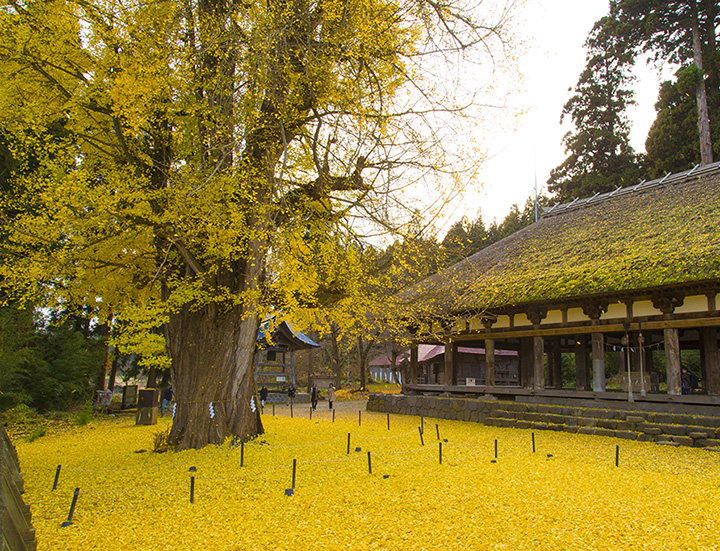
That you can meet the landscape of the photogenic autumn, 1055 (1055) and Minamotono Yoriyoshi (Everyone, a one, than, OK.), kansei, Furuyashiro in Kitakata-shi. The sacred tree of an age of the tree for 800 years and the big gingko in the precinct will color in gold and set an overwhelming existence sense free at the middle of October. To the extent there is a hall of worship of the architecture representative of Heian period 44 pillars equal "Nagatoko" near the sacred tree, and I hold my breath in the harmony of the solemn building and the big gingko. It's also special around the middle of November a fallen leaf of a gingko begins to dance. The landscape of the highlights by which Art who spread a yellow carpet all over the aspect is just like is seen.
[Start of coloring] at the middle of ordinary year October.
[Best time] at the end ofordinary year October-at the middle of November.
[The kind of colored leaves] gingko
- Shingu Kumanojinja
-
- Keitokumachishingu, Kitakata-shi, Fukushima Kumano 2258 MAP
 It's a car from JR Kitakata Station, about 10 minutes
- 8:30-17:00 (12-March can inspect only holiday 9:00-16:00 on Saturday . Sunday.)
- No charge below the adult of 300 yen, the high school student of 200 yen and the junior high school student
- 0241-23-0775
- Free
Bandai area
3Bandai-san (It's BA N, Isa, oh.), gold line
A scenic route of the full length 17.6km satisfied with colored leaves
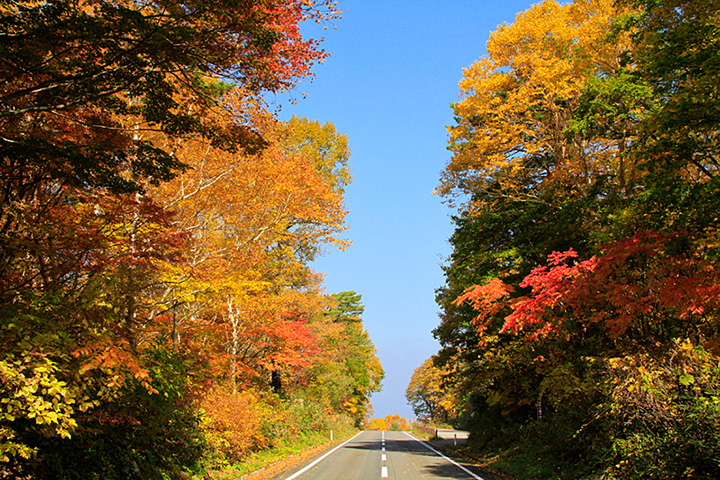
If I go by car, the scenic route where I go through Saimen in Bandai-san in north and south and connect from Hinohara lake (HI BARAKO) Bandai-machi "Bandai-san gold line" is recommended. The road where grand nature in Aizu can be enjoyed fully is the full length 17.6km. Even while a superb view point is many every direction stand with which I bustle as a waterfall of illusion and a starting point for a climb of Bandai-san and Nekoma KE mountain at Nozomi lake stand which wishes for Hinohara lake, it's "mountain lake stand" and "gold (I don't row.), flat" to want to visit by all means. That the Inawashiro lake deep blue in the brocade of colored leaves from a mountain lake stand is gapingly, contrast of a crater wall and colored leaves in Bandai-san where a violent rock surface is shown can enjoy the scenery which floats at a gold flat.
A gradation of colored leaves will call Fumoto from peak in Bandai-san at time at the beginning of October, and is seen, and a heart is investigated by the scene of the beautiful autumn.
[Start of coloring] at the end of ordinary year September.
[Best time] at the middle ofordinary year October-at the beginning of November.
[The kind of colored leaves] beech, Japanese oak and maple and others
- Bandai-san (It's BA N, Isa, oh.), gold line
-
- Bandai-machi, Yama-gun, Fukushima large section of a town Sarashina letter Umaaraiba-Mt. Hibara, Kitashiobara-mura Yunohira MAP
- It's a car from about 35 minutes and Banetsu-expressway Bandai-kawahigashi IC by car from JR Kitakata Station, about 20 minutes
- When freezing※ at the middle ofApril-at the middle of November, there is Road Closed.
- Free
- 0241-32-2349 (Ura-bandai tourist association)
- Free
4Bandai-san Enichi-ji (it's BA N, Isa, oh, Enichi-ji) Shiryokan Museum (historic site Enichi-ji mark)
The deep red Japanese maple which colors a garden is impression enough.
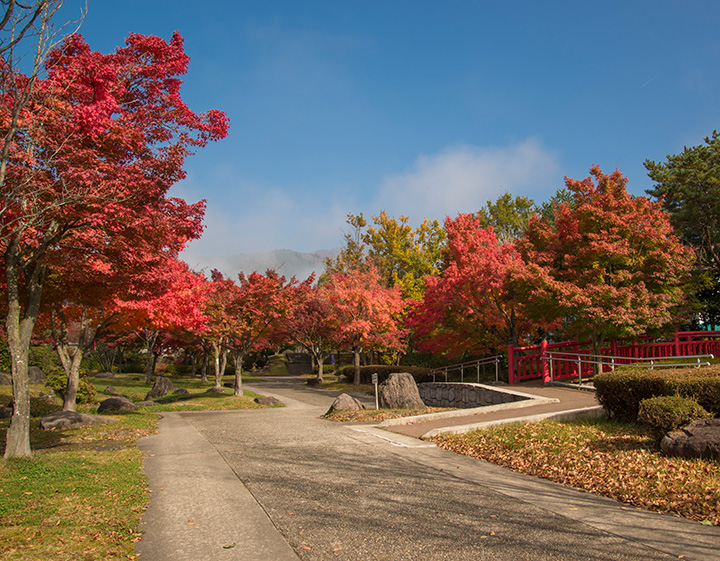
Preservation of cultural assets related with a place by the Aizu Buddhist origination "Enichi-ji" and exhibited Shiryokan Museum with history in 1200. A Buddhist temple and stupa Japanese yew (the temple how do investigated) stood close together and was the grave Buddhist city where a lot of temple monks and armed monks lived in the golden age. Restored vermilion-lacquered "Golden Hall " etc. in addition to the gate, the mausoleum and the hall where history is in about 17,000 square meters of site is also here and there now. Even while the simple landscape which seems to be Sato temple spreads, the autumnal tints around the Shiryokan Museum are striking in particular. A deep red Japanese maple is planted aside of the pond and the channel where a stream flows, and it's impressed by the beautiful scene.
There is an old private house cafe near the Shiryokan Museum, and I can also receive good coffee after walk.
There is also road station around about 20 minutes on foot from Bandaimachi Station, so while going sightseeing how about visiting?
[Start of coloring] at the middle of ordinary year October.
[Best time] at the end ofordinary year October-at the middle of November.
[The kind of colored leaves] Japanese maple and metasequoia and others
- Bandai-san Enichi-ji (it's BA N, Isa, oh, Enichi-ji) Shiryokan Museum (historic site Enichi-ji mark)
-
- Bandai, Bandai-machi, Yama-gun, Fukushima Teranishi 381 MAP
- From JR Bandaimachi Station, about 20 minutes on foot
- April 10-November 30 9:00-17:00 (16:30 last reception)
- Open everyday during a period
- Common admission ticket (Kondo and an inner gate are included.) The public and no charge below the college student of 500 yen and the high school student
- 0242-73-3000
- Free
5Nakatsu-gawa ravine
Be absorbed, Art great outdoors bore. The autumnal tints like the carpet of brocade are excellent.
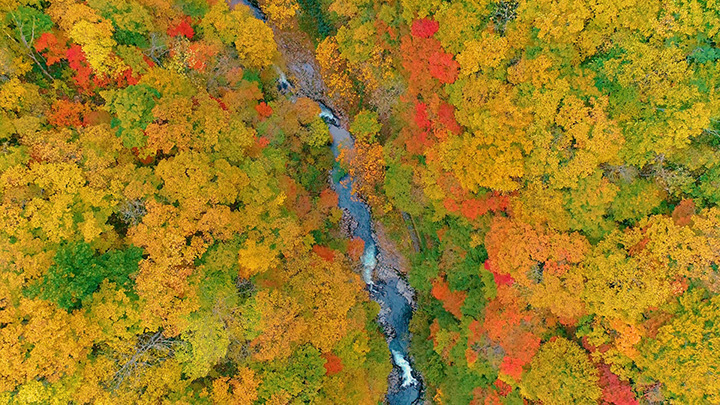
Tohoku is the spot of colored leaves I'd like to visit at Ura-bandai in autumn when it takes pride in its outstanding canyon's beauty (When, oh, it's held.) They're rapids, the cliff cliff where I also come to height 100m and a place by the land of mystery where a thick wildwood ranges at a large ravine of the length 10km in the source in Nakatsugawa where 1 of three lake Hinohara lake (HI BARAKO) and Ura-bandai as well as Onogawako flow into Akimotoko.
The condition by which a beech, a maple and a larch will feel color and a carpet of brocade is wide at time at the middle of ordinary year October, the scale sense, much. If Tsutomu Osako's colored leaves are enjoyed slowly, the "Akimoto* Nakatsu-gawa ravine sight-seeing way" where you can come down to aside of the "Nakatsugawa rest house" with a parking to a ravine is recommended. Even one way for about 15 minutes and on the bridge can also enjoy colored leaves by various viewpoints at a dry riverbed. Green of a coniferous tree, red of a broadleaf tree and yellow will be satisfied while taking a walk through an interwoven superb view freely.
[Start of coloring] at the beginning of ordinary year October.
[Best time] at the middle ofordinary year October-at the beginning of November.
[The kind of colored leaves] beech, maple and larch and others
- Nakatsu-gawa ravine
-
- Kitashiobara-mura, Yama-gun, Fukushima Hinohara MAP
- It's a car for about 28 minutes from Banetsu-expressway Inawashiro IC by car from JR Inawashiro Station, about 26 minutes
- 0241-32-2349 (Ura-bandai tourist association)
- Free
Inawashiro area
6Hanitsu (for, NITSU) shrine
A precinct is dyed in red carpet Isshiki.
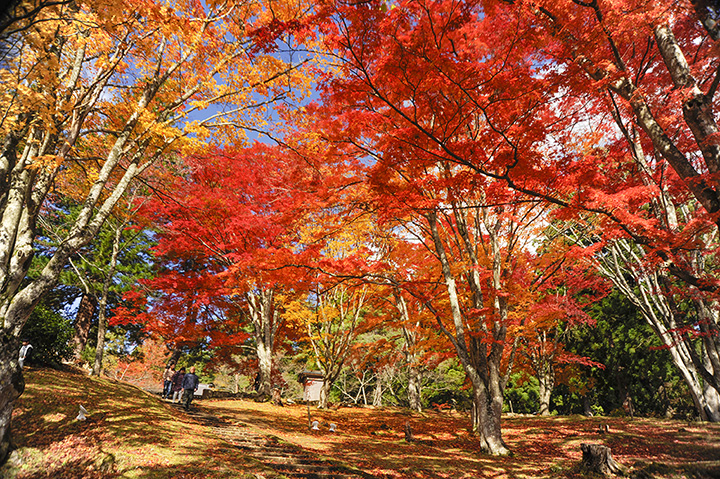
The shrine where they're the first seigneur who built a foundation in Aizu and the Hoshina Masayuki (stellar rawness, Yuki) official relation that you can meet the view over which a carpet of a deep red maple spreads. While taking a drive with about 10 minutes by car from Inawashiro Bandai-kogen IC, it's easy to drop in, and when autumn comes, it's the spot many people visit with the colored leaves in mind.
Beauty which is to the extent the maple and the gingko in the shrine entrance are dyed from the end of blooming October of colored leaves to the beginning of November, and I gaze at symbolic white Otorii and contrast of a deep red maple in particular. When a maple begins to scatter, a precinct is buried by the fallen leaf dyed red, and its view is a word of highlights.
[Start of coloring] at the middle of ordinary year October.
[Best time] at the end ofordinary year October-at the beginning of November.
[The kind of colored leaves] maple, maple and gingko and others
- Hanitsu (for, NITSU) shrine
-
- Inawashiro-machi, Yama-gun, Fukushima Azami neyama 1 MAP
- It's a car from JR Inawashiro Station, about 10 minutes
- 10:00-16:00 (in 4-November, weekend holiday 9:00-17:00)
※ The worship is usually possible for 365 days per 24 hours. - Open everyday
- Free
- 0242-62-2048 (Inawashiro tourist association)
- Free
7Tatsuzawa Fudoutaki
Indeed fall in flamboyant autumn. meibaku circled by a beech and a maple
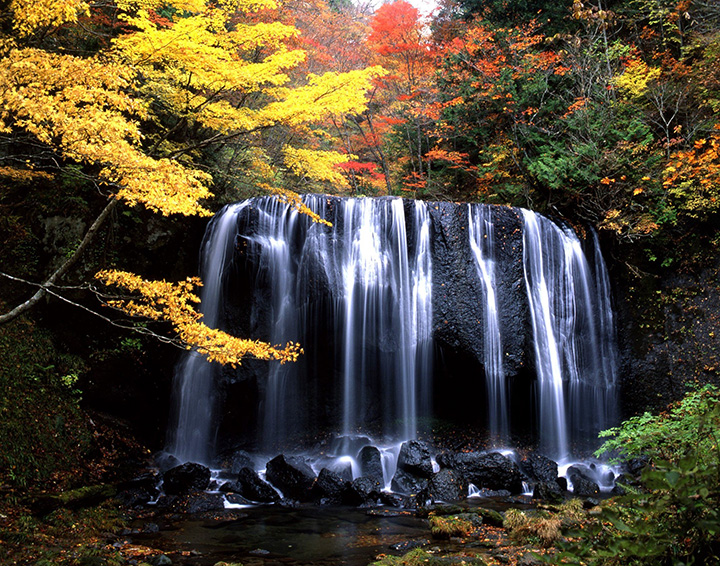
It's meibaku where Mt. Adatara (Enemy cod and, oh.) is in the immovable river where Funagira Koyama of 1,667m located in a chain of mountains (MYOU JIN which is bran and, oh.) was made a source that the colored leaves with the vivid color as well as fall with the impression can be enjoyed. "Nakanosawa hot spring" when he's entering a mountain in the interior in hot spring district at the deep place for about 15 minutes by empty car, Taki who shone out as a school of Shugendo formerly is seeing.
The rock surface where a beech and a maple are black in the wildwood where I burn, the form that "Metaki" who shows a quiet flow near marches with the "male waterfall" where water is a hero of the gap 10m which drops like a bamboo screen and width 16m is beauty artistic surely. Fudo is deified by Takimoto, so it's worship by all means. The scenery by which the minus ion I'd like to see forever is much seems to heal a heart and build.
[Start of coloring] at the beginning of ordinary year October.
[Best time] at the middle ofordinary year October-at the end of October.
[The kind of colored leaves] beech, maple and horse chestnut and others
- Tatsuzawa Fudoutaki
-
- Fukushima prefecture Inawashiro-machi Tatsuzawa area MAP
- It's a car from JR Inawashiro Station, about 28 minutes
- 0242-62-2048 (Inawashiro tourist association)
- Free
< the high plain resort hotel which wishes for Bandai-san>
After enjoying sightseeing, how about some time of the relaxation by a resort hotel in which the base in Bandai-san is located? It's possible to feel history in Aizu and culture in the stay in the hotel.
8Bandaisan Onsen Hotel by Hoshino Resorts
The inn where you can enjoy Aizu culture fully and have time actively at any time of the year around

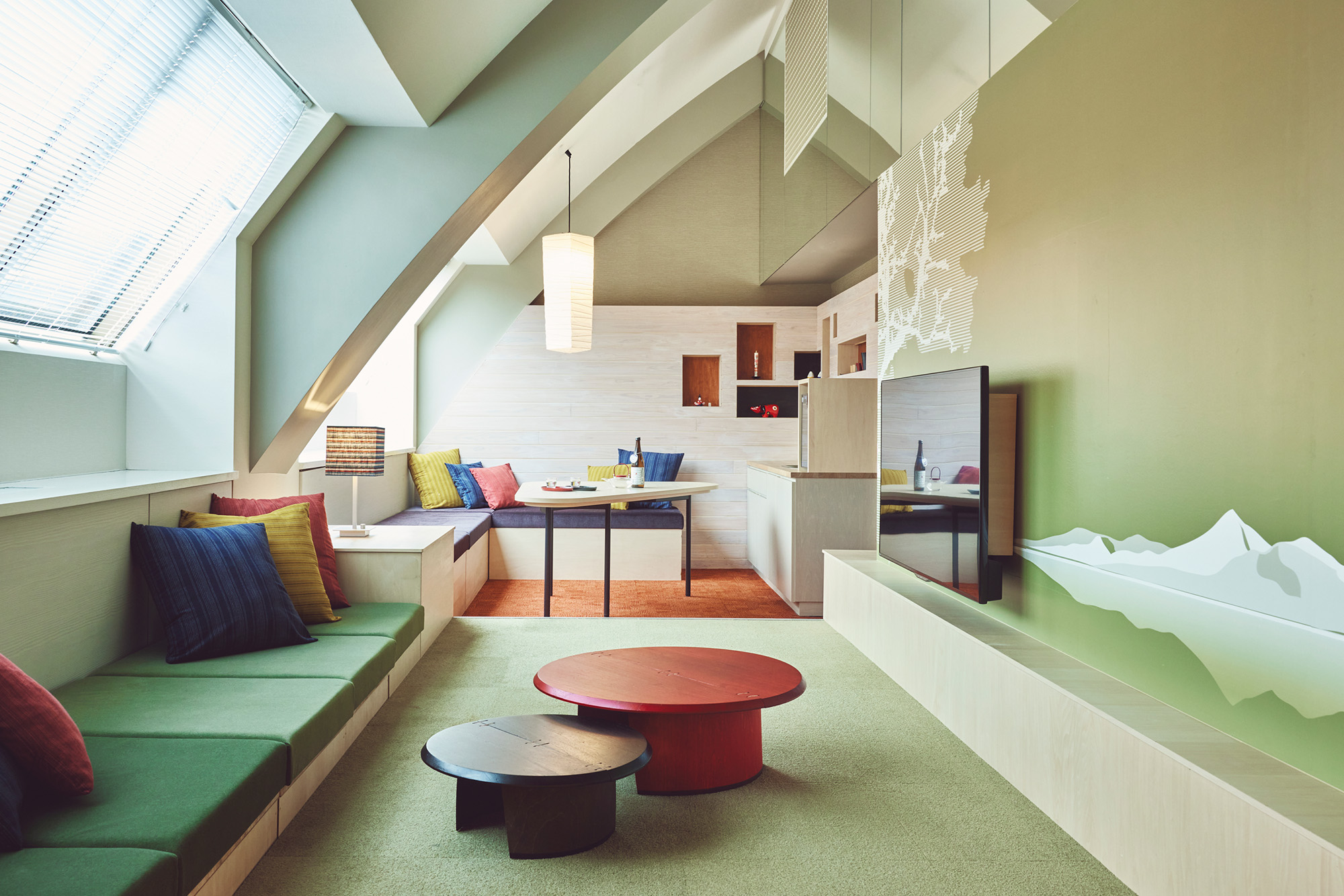
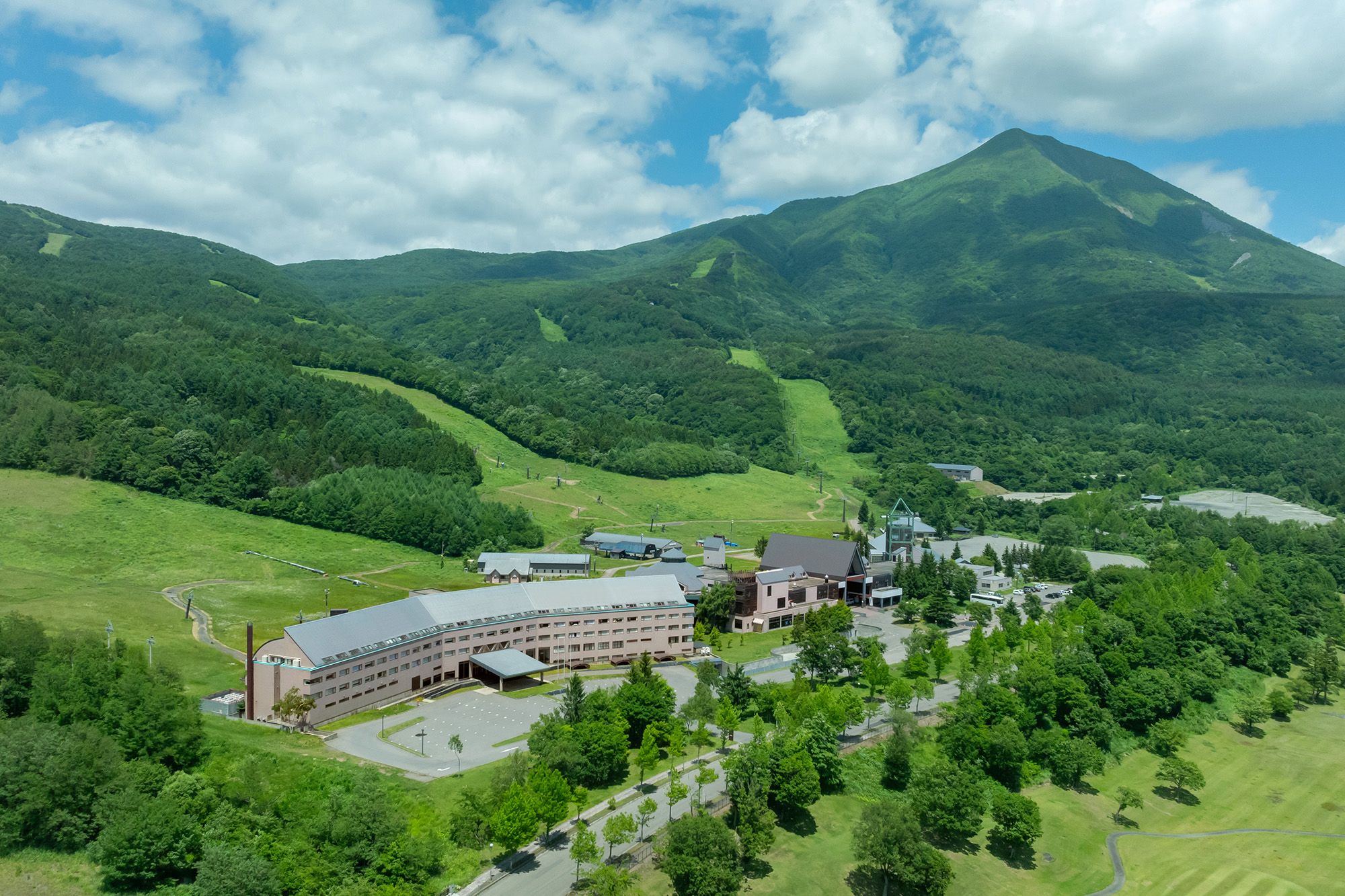
"Bandaisan Onsen Hotel by Hoshino Resorts" where "Bandai-san" where Japan one hundred famous mountain is one is located in the place where I dominate immediateness and wish for the "Inawashiro lake" brilliant like Kagami under the eyes. You can enjoy the stay which has complete set of heated pool, spa and hot spring and touches the Aizu culture which isn't learned about. You can burn with colored leaves from fresh green and have time actively until the season wrapped in Miyuki. Please enjoy a high plain resort stay in the grand nature and the change in four seasons.

- Bandaisan Onsen Hotel by Hoshino Resorts
-
- Bandai-machi, Yama-gun, Fukushima large section of a town Sarashina letter Shimizuhira 6838-68 MAP
- It's curtesy transportation bus from JR Bandaimachi Station, about 15 minutes
- 050-3134-8094 (reservation center /9:30-18:00)
 Bandaisan Onsen Hotel by Hoshino Resorts Reservation site.
MAP
- Aizu-wakamatsu area
- Kitakata area
- Bandai area
- Inawashiro area
- < the high plain resort hotel which wishes for Bandai-san>
-
- Hoshino ResortsProperty around here

Local Guide which took charge of this article

- Saori Kuji.The active girl Aizu love overflows
Bandaisan Onsen Hotel by Hoshino Resorts
Fukushima-ken and Yama-gun
The base in Aizu-bandai-san and the hotel where I wish for Inawashiro lake under the eyes. Abundant nature and Aizu culture can be enjoyed fully.

It's a taxi from Direction JR Bandaimachi Station, about 15 minutes
- A room charge example
- 1 night, 1 person \12,000-