





Who is Koizumi Yakumo, a great writer who loved Japan? A literary and historical tour in Matsue, the setting of the morning drama "Asadora
-1-1024x682.jpg)
Koizumi Yakumo (Lafcadio Hearn) is the author of "Kwaidan" (ghost stories), which includes "Hoichi the Earless" and "The Snow Woman". Why did Hearn, who was born in Greece and raised in Ireland, visit Japan and become the Japanese "Koizumi Yakumo"? The broadcast of a TV drama based on Yakumo and his wife, Setu, has brought his life into the spotlight.
Yakumo visited and moved to many places in Japan. Among them, Matsue City in Shimane Prefecture was the place where he was destined to meet Setsu and find beauty in the ancient Japanese customs and spirituality of the Japanese people.
How about a trip to Matsue, which Yakumo called "the capital of the land of the gods" and where his footprints remain strong, to visit places associated with him?
1. who is Koizumi Yakumo, who loved Japan and spread Japanese culture abroad?
Born in Greece. After writing in the U.S., moved to Japan
.jpg)
Koizumi Yakumo, born Patrick Lafcadio Hearn in 1850 on the Greek island of Lefkada and raised in Ireland, lost the sight in his left eye at the age of 16 in a school accident, and at 19 moved to America to pursue his career as a journalist.
While expanding his activities as a travel writer and translator, Yakumo became fascinated with Japanese culture through the World's Fair held in New Orleans and the English translation of "Kojiki," etc. In 1890, he arrived in Japan, which was his long-cherished dream.
Assigned to Matsue. Encounters Koizumi Setsu.
.jpg)
After arriving in Japan, Yakumo was assigned as an English teacher at the Shimane Prefectural Junior High School and Normal School in Matsue. Koizumi Setsu was hired to take care of his personal needs. Setsu came to live and work at Yakumo's house, and the two eventually came to live together as husband and wife.
The "Herne language" was born from the language barrier between English and Japanese. Herun" is a term of endearment used by Matsue residents to call Yakumo "Herun-san," "Herun-sensei," and so on. The two men developed a strong bond through this unique language, which omits Japanese particles and uses a mixture of English and Japanese in word order.
Life in Matsue, the "Capital of the Land of the Gods.
.jpg)
Yakumo was an English teacher in Matsue. Through interaction with her students and the people of the town, she discovered the appeal of the ancient Japanese customs, culture, and spirituality that remain in the land of eight million gods and goddesses.
He wrote about his day in Matsue in "The Capital of the Land of the Gods," a chapter of his first book after coming to Japan, "Unknown Faces of Japan. The book vividly depicts scenes of the castle town of Matsue, including its streets, the people of the city, nature, and living creatures, as well as legends, with great sensitivity.
Obtains Japanese citizenship at the age of 46. And to the birth of "Kwaidan
.jpg)
After leaving Matsue, where he lived for about one year and three months, Yakumo moved to Kumamoto, Kobe, and Tokyo, where he taught at Imperial University and Waseda University. The name "Yakumo" is said to be derived from "Yakumo tate," a Japanese word for "Izumo" in the oldest waka poem in Japan, which appears in the Kojiki (Records of Ancient Matters).
Blessed with three sons and a daughter, Yakumo introduced Japanese culture to the rest of the world through his various works until his death in 1904 at the age of 54. The source of his late masterpiece, "Kwaidan," was a collection of ancient Japanese folk tales and ghost stories told to Yakumo by Setsu, who loved stories. The ghost stories, which were created as "retellings" based on Yakumo's unique interpretations and expressions, are filled with a sense of awe, human emotion, sadness, and nostalgia amidst the horror, and leave a deep aftertaste as works of literature.
These ghost stories include "Hoichi without Ears," "Snow Woman," "Rorokurokubi," and "Mujina.
Yakumo and Setsu together spun a "ghost story" that is still read today as an immortal masterpiece known by all. 2.
2. places related to Yakumo that you should visit in Matsue
Koizumi Yakumo Memorial Museum
.jpg)
Located next to the former residence of Yakumo Koizumi, the memorial museum is headed by his great-grandson, Bon Koizumi. Based on the concept of Yakumo's open mind, the museum introduces his life and achievements through graphics and videos.
The museum houses and exhibits a collection of his personal belongings, including desks, chairs, clothing, and xeroxes, as well as his handwritten manuscripts, first editions, family photos, and other valuable items. If you are interested in Yakumo's works, please visit the library where his books and related publications are lined up. Take your time and immerse yourself in the world that Yakumo spun.
.jpg)
- Koizumi Yakumo Memorial Museum
-
 322 Okutani-cho, Matsue City, Shimane Prefecture MAP
 Approx. 20 min. walk from Matsue Shinjiko Onsen Station on the Ichibata Line
Approx. 10 min. by car from JR Matsue Station 16 min. ride on the "Gurutto Matsue Lake Line Bus" from JR Matsue Station, a short walk from the "Koizumi Hearn Memorial Museum Mae" stop.
 9:00 - 18:00, October - March: 17:00 (admission until 30 minutes before closing)
 Open all year round (with several maintenance breaks each year)
 Adults 600 yen, elementary/junior high school students 300 yen, two-for-one ticket with the former residence of Hearn Koizumi 800 yen for adults, 400 yen for elementary/junior high school students
 0852-21-2147
 None
None
Koizumi Yakumo's Former Residence
.jpg)
Yakumo lived in Matsue for about one year and three months. The latter five months of his life were spent in the Negishi family's samurai residence, which is now open to the public as his former residence. Yakumo said that he wished to live in a samurai residence with a garden. In one of his books, "Japanese Gardens," he wrote about the beauty of the trees and stones and the fascination of the garden where insects and other creatures lurk. At the former residence, the beautiful garden and other places remind us of the time when Yakumo and Setsu lived there.
.jpg)
- Koizumi Yakumo's Former Residence
-
- 315 Kitabori-cho, Matsue City, Shimane Prefecture MAP
- Approx. 20 min. walk from Matsue Shinjiko Onsen Station on the Ichibata Line
Approx. 10 min. by car from JR Matsue Station - 16 min. ride on the "Gurutto Matsue Lake Line Bus" from JR Matsue Station, a short walk from the "Koizumi Hearn Memorial Museum Mae" stop.
- 9:00 - 18:00, October - March: 17:00 (admission until 30 minutes before closing)
- Open all year round (with several maintenance breaks each year)
- Adults 400 yen, elementary and junior high school students 200 yen, two-for-one ticket with Koizumi Hearn Memorial Museum 800 yen for adults, 400 yen for elementary and junior high school students
- 0852-21-2147(Hearun Koizumi Memorial Hall)
- None
3. visit a place where ghost stories and strange tales still live on
Matsue Bridge
.jpg)
This bridge spans the Ohashi River, which separates Matsue City from north to south, and was built in 1608 when Matsue Castle was constructed. The current bridge is the 17th generation, and is well known to citizens as a symbol of Matsue, the city of water.
The "Gensuke Memorial Monument" catches the eye at the south end of the bridge. Gensuke was used as a human sacrifice because of the difficulty of the initial construction work, and the bridge pier in the center was called "Gensuke Pillar". Yakumo wrote about this sad legend in "Unknown Faces of Japan.
In the same book, Yakumo also described the sound of clogs of people crossing the bridge as musical, like a grand ball, and unforgettable.
(松江観光協会提供).jpg)
- Matsue Bridge
-
- Matsue City, Shimane Prefecture MAP
- 15 min. walk from Matsue Shinjiko Onsen Station on the Ichibata Line
12 min. walk or 4 min. drive from JR Matsue Station - 0852-27-5843(Matsue Tourist Association)
- None
Matsue Castle
.jpg)
Yoshiharu Horio, the founder of the Matsue government, built the castle from 1607 to 1611. It is one of only 12 surviving castle keepers in Japan and is designated as a National Treasure. On the top floor, there is a watchtower with a 360-degree view of the city of Matsue and Lake Shinji.
Various stories about the construction of Matsue Castle remain. When the construction of the stone walls went wrong, a beautiful girl who could dance well was chosen to serve as a human pillar. Since then, Bon Odori dances have not been held near Matsue Castle because the castle would be shaken if there were Bon Odori dances held there.
In his book "Unknown Faces of Japan," Yakumo described Matsue Castle as a dragon made of a collection of bizarre things and mentioned the story of this girl.
(松江観光協会提供).jpg)
- Matsue Castle
-
- 1-5 Tonomachi, Matsue City, Shimane Prefecture MAP
- Approximately 16 minutes on foot from Matsue Shinjiko Onsen Station on the Ichibata Line
Approximately 7 minutes from JR Matsue Station by car - About 10 minutes from JR Matsue Station by "Gurutto Matsue Lake Line Bus", about 2 minutes walk from "National Treasure Matsue Castle (Otemae)" stop
- Honmaru 8:00-18:30 (October to March: ~17:30),
Tenshukaku: 8:30-18:00 (Oct-Mar: ~17:00) *Reception closes 30 minutes before closing. - No holidays
- Adults 800 yen, elementary and junior high school students 400 yen
- 0852-21-4030 (Matsue Castle Park Management Office)
- Not available (use municipal Matsue Castle Ote-mae Parking Lot, etc.)
Fumonin Temple
.jpg)
A temple of the Tendai sect, it was built around 1607-1611, when Matsue Castle and the castle town were constructed. The temple grounds are surrounded by an elegant garden with a pond called Shinji-ike.
The "Kangetsu-an" (a tea house) on the temple grounds is a tea house in the Hosokawa Sansai style, where Harusato Matsudaira, the seventh lord of the Matsudaira family of the Matsue Domain and a feudal lord tea master with the title of "Fumai" (a lord of tea ceremony), often enjoyed tea ceremonies. It is said that Yakumo also learned tea ceremony at Kangetsuan.
There is a legend that if one chants a song called "Kakitsubata" on the "Azuki Togi Bridge" in front of the Fumonin Temple, it is said to bring bad luck.
.jpg)
- Fumonin Temple
-
- 27 Kitada-cho, Matsue City, Shimane Prefecture MAP
- Approximately 25 minutes on foot from Matsue Shinjiko Onsen Station on the Ichibata Line
Approximately 7 minutes from JR Matsue Station by car - 14 minutes from JR Matsue Station by "Gurutto Matsue Lake Line Bus", about 7 minutes walk from Shiomi Nawate Bus Stop.
- Free to visit, Kangetsuan 8:00-16:00
- Kangetsuan is open on Tuesdays.
- Kangetsuan 300 yen, 1,000 yen with green powdered tea
- 0852-21-1095
- Free of charge
Shiroyama Inari Shrine
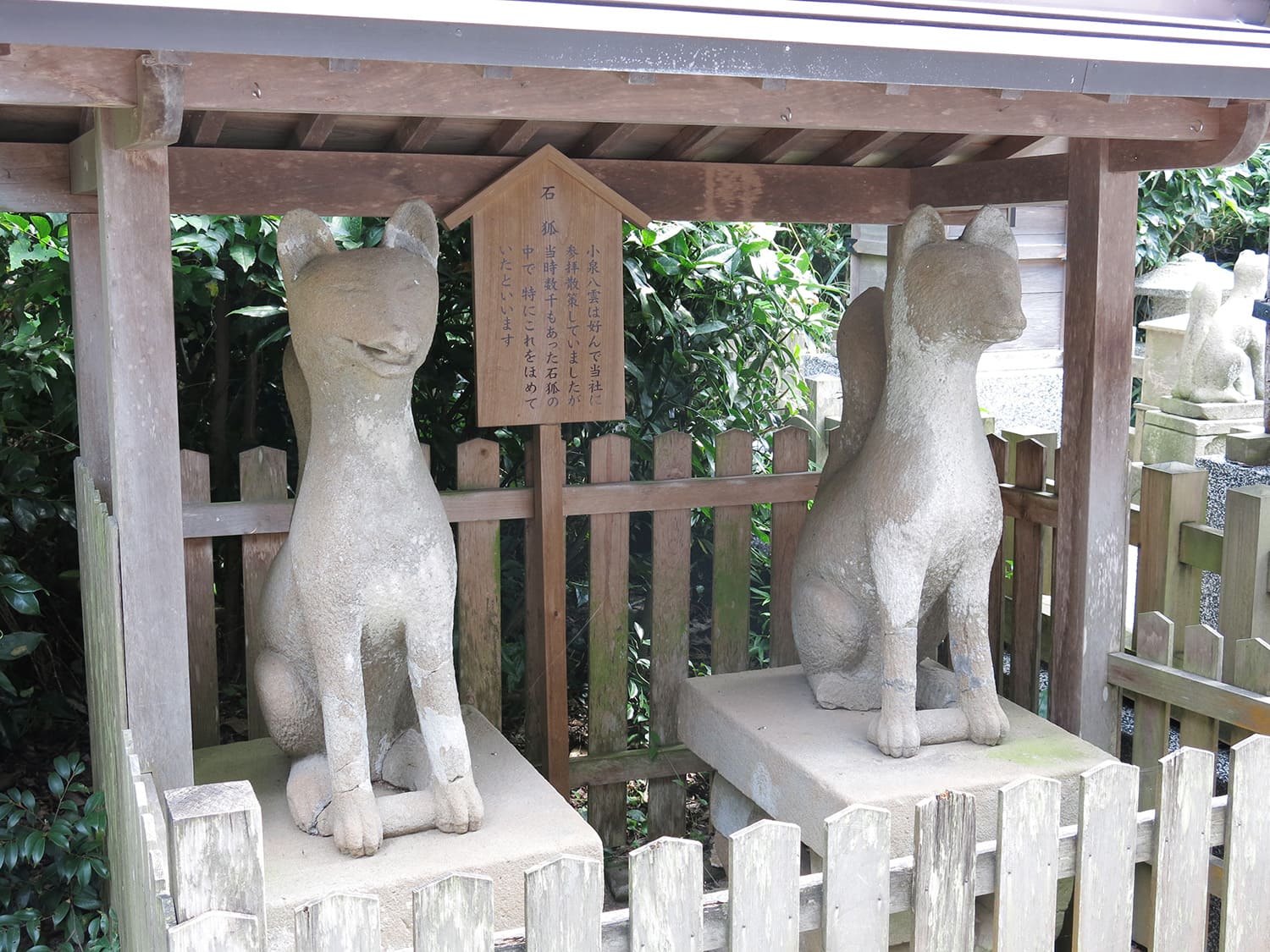
Founded in 1638 by Naomasa Matsudaira, the first lord of the Matsue Domain Matsudaira family, the shrine's "Horanenya" ceremony held every 10 years is one of the three largest boat Shinto rituals in Japan, and the parade of about 100 boats is a spectacular sight.
Stone foxes of various shapes and sizes line the grounds of the shrine. It is said that Yakumo was attracted by the unique stone foxes and often visited the shrine.
Yakumo's book, "Unknown Faces of Japan," contains a legend about the shrine's founding. When Matsudaira Naomasa entered Matsue, a beautiful boy named Inari Shinzaemon appeared to him and told him that he would protect the castle from fire if he built a house for him. It is said that a shrine was built there, and numerous stone foxes still guard the shrine today.

- Shiroyama Inari Shrine
-
- 477 Tonomachi, Matsue City, Shimane Prefecture MAP
- Approx. 20 min. walk from Matsue Shinjiko Onsen Station on the Ichibata Line
Approximately 7 minutes from JR Matsue Station by car - Approx. 10 min. ride on the "Gurutto Matsue Lake Line Bus" from JR Matsue Station, approx. 10 min. walk from the "National Treasure Matsue Castle (Otemae)" stop.
- Free to visit
- 0852-21-1389
- Not available (use municipal Matsue Castle Ote-mae Parking Lot, etc.)
4. bring a souvenir of Yakumo's favorite Japanese sweets
Ichirikido Kyoten Honten "Hearn's Yokan
.jpg)
Along with Kyoto and Kanazawa, Matsue is famous as one of Japan's "Three Great Sweets Towns. The tea ceremony culture established by Matsudaira Jirigo (tea name: Fumai), the seventh lord of the Matsudaira family of the Matsue Domain, known as a feudal lord tea master, is still alive today. Ichirikido was founded in the Horeki era (1751-1764) of the Edo period (1603-1868), and has been a long-established confectionary shop serving the Matsue domain for generations since its foundation.
Yakumo, who was said to have had a sweet tooth, particularly enjoyed yokan, and even after moving to Tokyo, his wife Setsu would order it from Matsue. Hearn's Yokan" is a proudly reproduced product based on the recipe written by the sixth generation head of Ichirikido, in order to bring back the taste of those days.
.jpg)
- Ichirikido Kyoten Honten
-
- 53 Suetsugu Honmachi, Matsue City, Shimane Prefecture MAP
- 15 min. walk from Matsue Shinjiko Onsen Station on the Ichibata Line
15 minutes on foot or 5 minutes by car from JR Matsue Station - Approximately 7 minutes by "Gurutto Matsue Lake Line Bus", 5 minutes walk from Kyobashi stop
- 10:00 - 18:00, Sunday - 17:00
- Thursdays
- 0852-28-5300
- No parking (use Kyoten Shopping Street Parking)
5. enjoy the world of Hoshino Resorts KAI Tamatsukuri through the "Journey to Koizumi Yakumo" program.
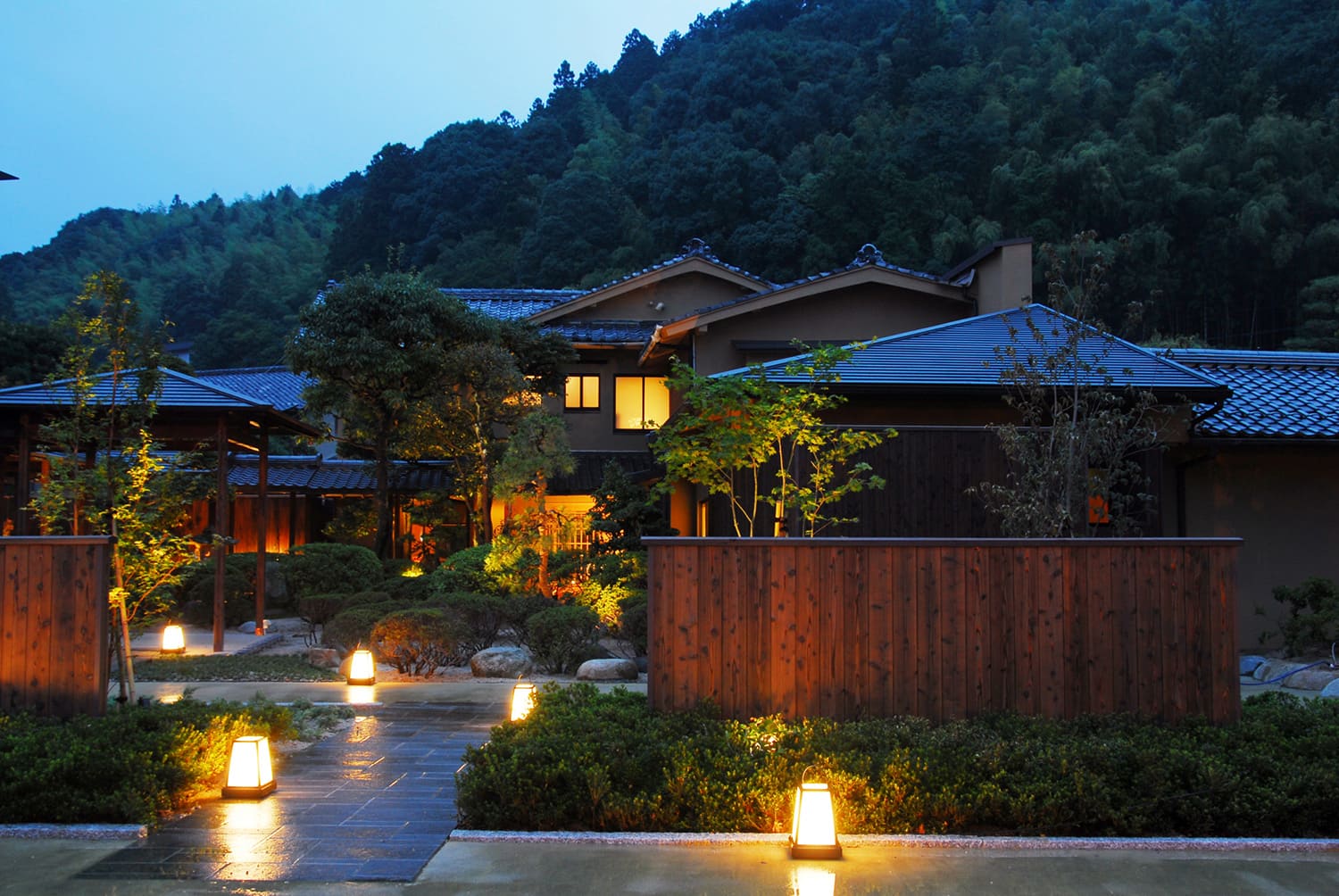
Hot spring ryokan "Hoshino Resorts KAI Tamatsukuri" KAI" is located in Tamatsukuri hot spring ryokan, which is said to be one of the oldest hot springs in Japan. The hotel offers a variety of activities including bathing in the outdoor hot spring baths in all Guest rooms, seafood from the San'in region, sake from Shimane, the birthplace of Japanese sake, and traditional Shimane culture and folk art. Come learn more about Yakumo and immerse yourself in his worldview.
Take a rickshaw tour of places associated with Yakumo

In the "Rickshaw Guided Tour," you will ride a rickshaw, which was a favorite of Hearn's, to Koizumi Hearn's former residence, Matsue Ohashi Bridge, the temple where his ghost stories were set, and other places associated with him. This private tour allows visitors to experience the scenery that Yakumo would have seen while being guided by a guide who knows Matsue inside and out.
Enjoy a ghost story while savoring the "Yakumo Sake Set
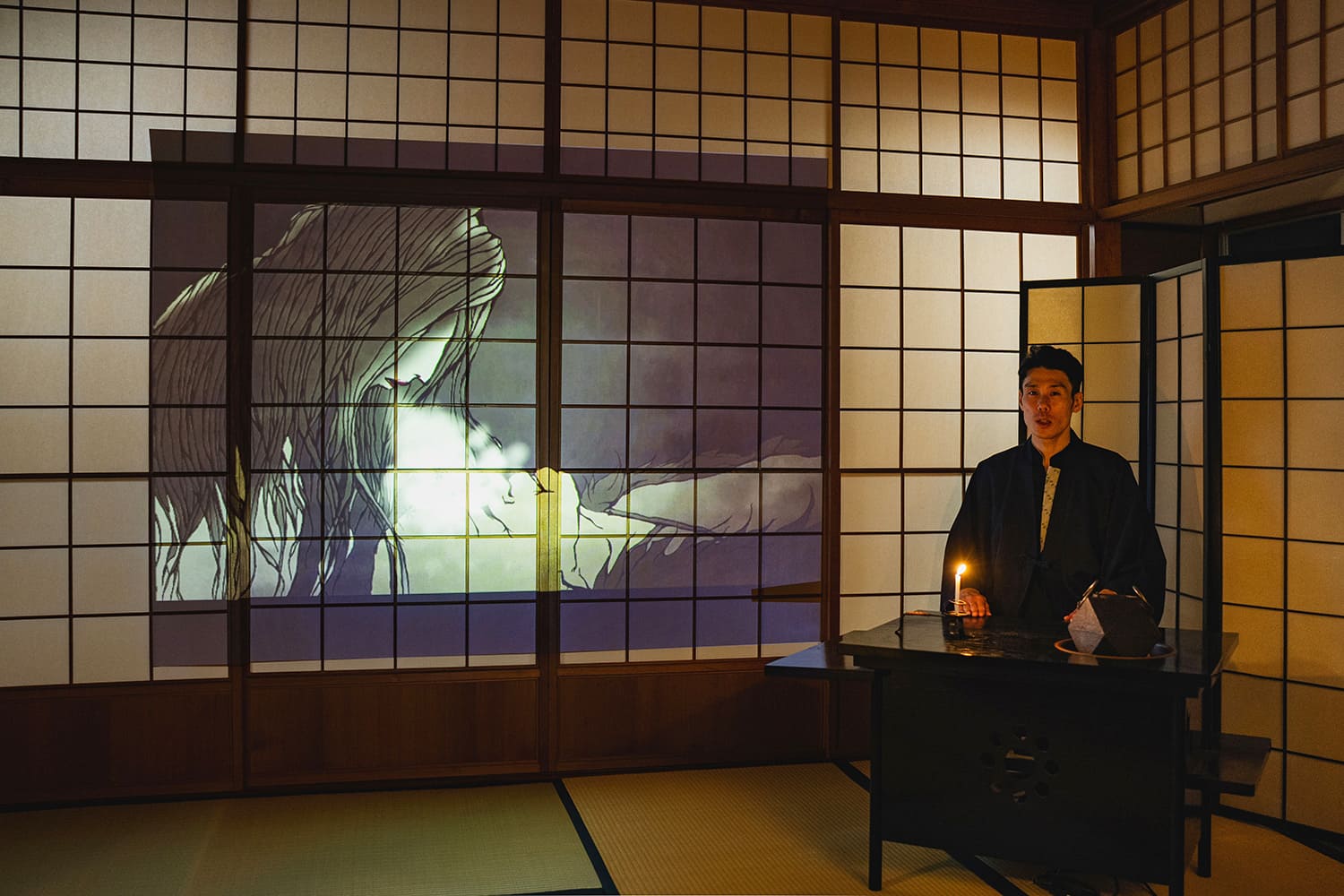
A fun evening event is the "Ghost Story Tea Room" held in the museum's tea room. First, there will be an explanation of Yakumo's life and the background of his writing "Kwaidan," followed by a reading of "The Snow Woman" and "Hoichi the Earless" with an original video presentation, inviting you into the world of the ghost stories spun by Yakumo.
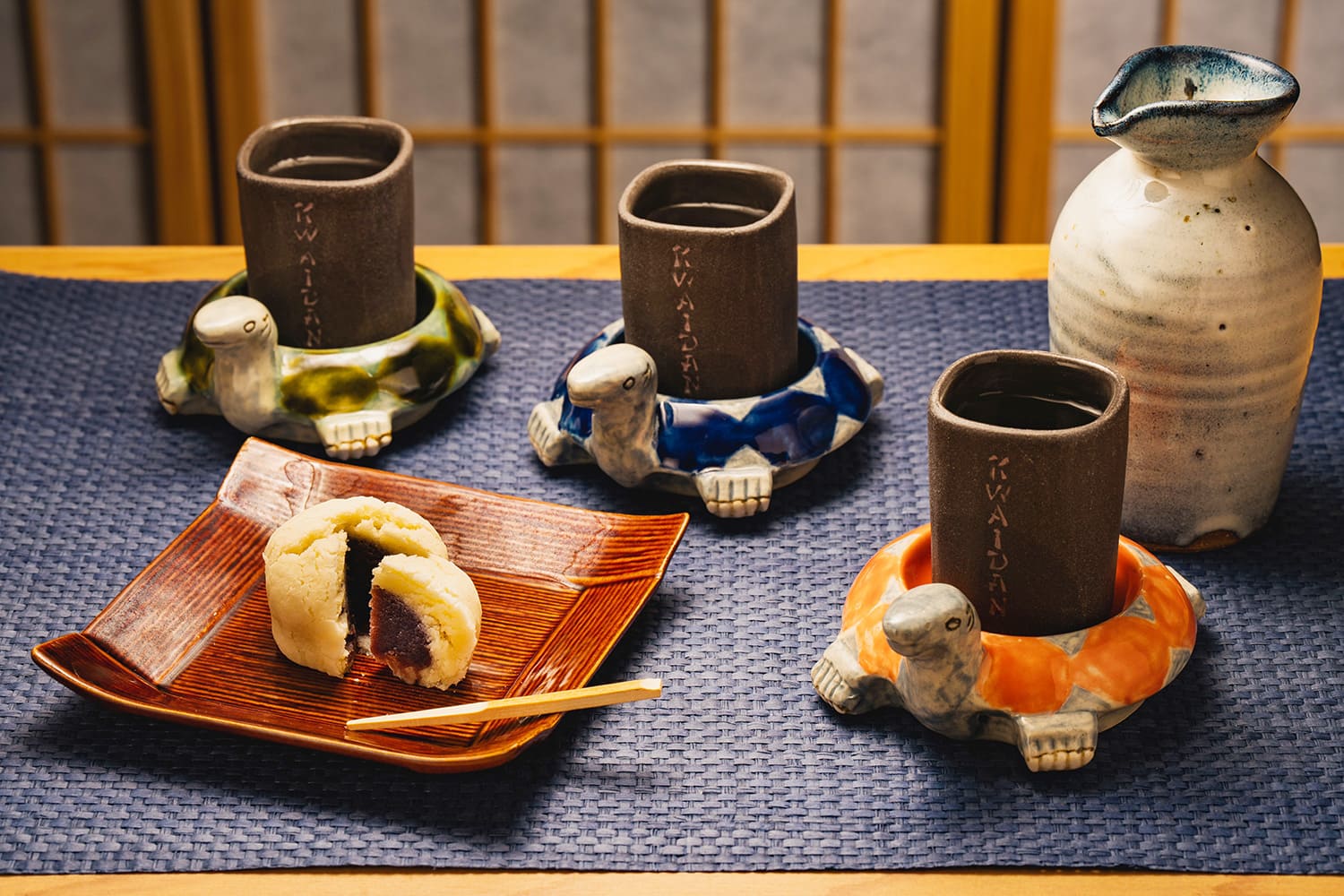
Along with the masterpieces, visitors can enjoy "Yakumo-shigure," a Japanese confectionery that Yakumo enjoyed as a snack with his evening meal, and "Yakumo-shu Set," a set of Japanese sake. The Kiomishigure is a Hoshino Resorts KAI Tamatsukuri original that uses sake for the red bean paste. Three types of sake are available, including nigori sake. You can enjoy a gem of a story together with beautiful sake.
- Hoshino Resorts KAI Tamatsukuri
-
- 1237 Tamatsukuri, Tamayu-cho, Matsue City, Shimane Prefecture MAP
- Approximately 20 minutes by car from JR Matsue Station
5 minutes from JR Tamatsukuri hot spring station by car - 050-3134-8092 (Office hours: 9:30 - 18:00)

Michikusa experts who wrote this article
-
Kaori Haraguchi
Writer and editor. After working as a writer and editor for a travel publishing company, I became independent. Writes mainly for travel guidebooks, information magazines, and websites, and sometimes illustrates. She also works with her husband, a photographer, as a unit. Qualified as a Japanese tea instructor.
 Michikusa's
guru
Hoshino Resorts KAI Tamatsukuri
An inn with Outdoor hot spring baths in all Guest rooms where you can enjoy the hot spring water for beautiful skin. You can also enjoy Kagura (Shinto music and dance) and Japanese sake, which is said to have originated in Shimane.