





I'll know the temperature Nasu high plain and clothes!


The north of Tochigi and the Nasu high plain in the Nasu town. A Nasu mountain range is in the Nikko national park district which towers, and now is also the active volcano which emits fumes and the high plain area spread in a southern slope in Chausudake (only SU,/altitude 1,915m). An altitude is about 300 m-1,200m. Such as ski can be enjoyed in winter with snow coolly, a vacation home area, leisure Property and hot spring are enriched in the area I have mercy and where it's abundant in nature every four seasons, and summer is the popular summer retreat close to 5,000,000 a year tourists visit.
The climate of the Nasu high plain is the high plain type which is cool and has low humidity. The temperature difference of the season and the day and night is big, and summer is also necessary for attention of a thunderstorm. I'll provide for the clothes added to the respective weather.
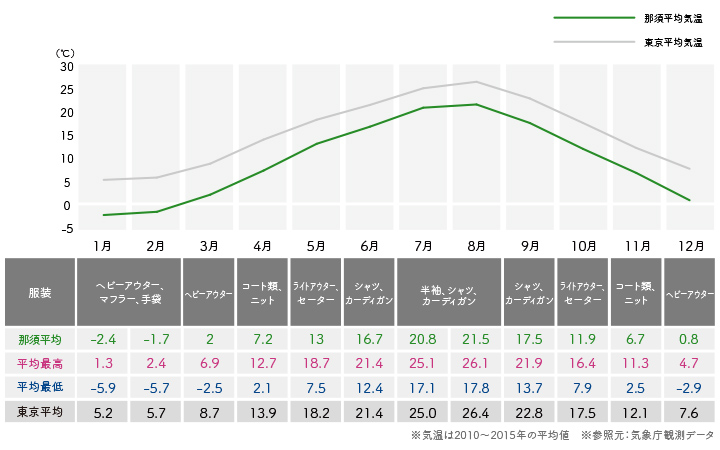
< the temperature Nasu high plain and clothes>
< AGURITSURIZUMORIZOTO which enjoys nature of Nasu fully>
< the temperature Nasu high plain and clothes>
About the spring (3-May) temperature Nasu high plain and clothes.

The average lowest temperature of March, um, 2.5 ℃. There is still snow and Nasu Takahara can also enjoy the snow viewing bath by ski and hot spring in this time. A heavy outer in a down court is indispensable, and the look of the midwinter is most suitable. It's at the end of March the snow has disappeared and that vegetation begins to bud. A cherry tree blooms from the middle of April, and Yae mountain cherry receives best time into G.W. at an altitude about 500 m spot. The temperature also rises and is cheerful warmly at the middle of May when 200,000 of Azalea of "Hachiman Azalea community" blooms. There is average highest temperature near 19 ℃, and you can spend the daytime by cut and sew of a long sleeve, but when the sun sets, the temperature does a nose-dive. The lowest average temperature will be about 7.5 ℃, and a court can't be left. I'll consider temperature gap and go out by the clothes taking arrive tends to have.
About the summer (6-August) temperature Nasu high plain and clothes.

The summer when green is glaring in Nasu high plain is the best season. The average temperature of June is about 15 ℃, and the refreshing climate also continues much on a fine day. Leisure at a lake and a forest, pasture Experience and a high plain hike, I enjoy myself, a fitting season.
The rainy season comes around the end of June when a hydrangea colors a Nasu highway. When the windbreaker which stops coldness and the wind cold by which it rains is prepared until time at the middle of July of the end of the rainy season, I'm relieved.
The average temperature of August is 21.5 ℃. The summer retreat which can be spent comfortably is bustle. The highest temperature is about 30 ℃ and the daytime leisure when I play up can spend great outdoors by short sleeves. But, it's said that the ultraviolet rays amount increases about 10 % compared with a plain, so a UV measure is needed. I'll prepare a Japanese half-coat thing for going out at night such as firefly enjoyment and a fireworks event because there is temperature difference about 10 ℃ day and night.
About the autumn (9-November) temperature Nasu high plain and clothes.

The average temperature of September is 17.5 ℃. There is also a day when I go down to about 10 ℃, and a morning and evening is showing signs of autumn quickly. Colored leaves start and are dyed in a gradation of beautiful brocade to the base in the middle of October from the peak neighborhood of the Nasu mountain range at the end of September. The average temperature of this time is about 12 ℃. When going out to a place famous for beautiful colored autumnal leaves such as a tea-grinding mortar (with the selling point of) mountain and "forest in" Nasu Heisei, it's preparation of an outer of a knit cardigan and a trench coat. When stoles is carried if the leg is stretched to the peak neighborhood, it's against the cold, convenient.
November when a winter visit is felt. The lowest temperature which will observe the first snow of the season at a Nasu mountain range at the first ten days of a month, and it's a high plain area at the last ten days, minus, ice needles fall and are seen. Such as wearing a sweater in the thick court, a travel packing will recommend you the winter specification.
About the winter (12-March) temperature Nasu high plain and clothes.

December when the day when the average temperature will be less than 0 ℃ is also often here. It begins to snow at the middle ten days and it changes to an aspect silvery snowscape. The temperature falls more and January and February are in the severe coldness. Snow, 10-, it's about 30 cm, so a down coat, gloves, a muffler and a body warmer will also do cold protection tightly in a high inner of a warmth retaining property snow boots and clothes for a foot. If a car is used, equipment of a snow tire and a chain is needed.
The Nasu high plain where the pleasure the winter such as skiing and strawberry picking is also filling. A visit to hot spring resorts of Nasuhot spring with an efficacious hot spring of 11 is at this time by all means including the venison hot water" which continues for about 1380 years in particular. The "hot spring tourist ticket" for which 3 points of hot spring can be used for 1000 yen of winter limitation is also issued, and a profitable sense is also much. It's different from a crowd in summer and you can spend some gentle time at hot spring district where it snows deep.
< AGURITSURIZUMORIZOTO which enjoys nature of Nasu fully>
After enjoying sightseeing, how about some time of the relaxation in Japan's first AGURITSURIZUMORIZOTO? "AGURITSURIZUMO" is a coined word of Italian AGURIKURUTURA (agriculture) and TSURIZUMO (sightseeing), and the nou Experience in land and natural Experience get away from the pother in the city, and enjoy a cultural exchange, go sightseeing.
Experience which touches production activities in an area and the meal which feels a favor in the earth can be tasted while enjoying the landscape of the area where farm produce is brought up during great outdoors abundant in a Nasu mountain.

Local Guide which took charge of this article
Hoshino Resorts RISONARE Nasu
Tochigi-ken and Nasu area
From Tokyo, about 90 minutes. High plain resort in Nasu which pauses in the forest


It's a shuttle bus from the Direction JRNasu Shiobara station, about 35 minutes
- A room charge example
- 1 night, 1 person \13,637-